
The geometry of: calm polygonal meditation spaces with integrated sound baths
The Geometry of Calm: Polygonal Meditation Spaces with Integrated Sound Baths
In an era defined by overstimulation and relentless connectivity, architecture is rediscovering silence—not as absence, but as form. The rise of polygonal meditation spaces integrated with sound baths represents a profound shift in how we conceive of spatial wellness. These geometric sanctuaries—where acoustics, light, and proportion converge—are redefining the boundaries between architecture, therapy, and sensory design. Across the globe, designers are sculpting stillness into form, crafting environments that resonate both physically and psychologically.
The Architectural Language of Stillness
Geometry has long been a vessel for spiritual experience. From the sacred Golden Ratio of ancient temples to the mandalas of Buddhist architecture, form has always been a medium for transcendence. Today’s architects reinterpret these archetypes through the lens of computational design and acoustic science. The polygon—particularly the hexagon and dodecagon—has emerged as a favored geometry for meditation spaces. Its balanced symmetry diffuses energy evenly, creating a sense of enclosure without confinement.
Inside these spaces, the interplay of angles and light becomes a meditative act in itself. Walls taper gently toward skylights, guiding the gaze upward. Materials such as rammed earth, brushed concrete, and warm timber absorb sound and soften visual noise. The result is a tactile geometry—an architecture that invites touch as much as contemplation. As seen in projects like the “Sonic Sanctuary” in Kyoto and the “Resonance Pavilion” in California, these designs merge ancient symbolism with modern sensorial precision.
Sound Baths as Architectural Medium
Sound baths—immersive experiences using resonant frequencies to induce relaxation—have evolved from wellness trend to architectural principle. In these new sanctuaries, sound is not an accessory but a structural element. Architects collaborate with acoustic engineers and sound artists to embed resonance chambers, subfloor transducers, and parametric surfaces that modulate vibration. The walls themselves become instruments, tuned to frequencies that harmonize with the human body’s natural rhythms.
Research from the field of acoustics shows that low-frequency vibrations can reduce stress and enhance meditative focus. This has inspired designers to integrate sonic diffusion panels and reflective geometries that distribute sound evenly across the space. In polygonal rooms, these reflections form standing waves that envelop the listener in a cocoon of harmonic resonance. The experience is less about hearing and more about feeling—an embodied meditation where architecture becomes the medium of mindfulness.
Material Resonance and Sensory Minimalism
Materiality plays a pivotal role in shaping the acoustic and emotional tone of these environments. Designers are increasingly turning to natural and sustainable materials—clay, cork, bamboo, and hempcrete—that possess both tactile warmth and sound-absorbing qualities. This approach aligns with the growing movement toward biophilic design, where nature’s textures and rhythms are reintroduced into built environments to promote psychological well-being.
In the “Polygonal Retreat” by Berlin-based studio Mæra, each facet of the structure is lined with perforated birch panels backed by wool insulation. The panels act as both diffusers and absorbers, creating a balanced acoustic field. A shallow reflecting pool at the center amplifies the sonic experience, transforming every tone into a gentle vibration that ripples through the air. Light, filtered through geometric apertures, shifts throughout the day, creating a choreography of shadows that mirrors the flow of sound.
Digital Craft and Parametric Calm
The precision of these spaces owes much to the rise of parametric design. Algorithms allow architects to simulate how sound waves interact with complex geometries, optimizing surfaces for resonance and diffusion. The result is a new kind of craftsmanship—digital yet deeply human. Each angle, curve, and cavity is tuned not for visual spectacle but for emotional equilibrium.
In London’s “Harmonic Dome,” designed by Studio Orphic, a twelve-sided structure was generated through parametric modeling to achieve a uniform acoustic field. The dome’s interior features a tessellation of triangular panels made from compressed mycelium—a biodegradable material that absorbs both sound and carbon. The space operates as a living organism, breathing and resonating with its occupants. This synthesis of digital precision and organic imperfection embodies what many designers now call “computational serenity.”
Geometry as Therapy
Beyond aesthetics, the geometric logic of these meditation spaces has measurable psychological effects. Studies in environmental psychology suggest that symmetrical and fractal geometries can lower cortisol levels and promote cognitive clarity. The polygon, with its equilibrium of edges and angles, offers a visual rhythm that the mind instinctively recognizes as stable. When paired with controlled acoustics, the result is a multisensory therapy that transcends traditional notions of space.
Architectural psychologist Dr. Lina Ferris describes this phenomenon as “geometric entrainment”—the process by which the body’s internal rhythms synchronize with spatial patterns. “In a well-designed polygonal meditation space,” she notes, “the architecture itself becomes a metronome for the nervous system.” This principle is increasingly being applied in hospitals, corporate wellness centers, and even urban micro-retreats, where compact polygonal pods offer moments of stillness amid metropolitan chaos.
Case Study: The Resonant Pavilion, California
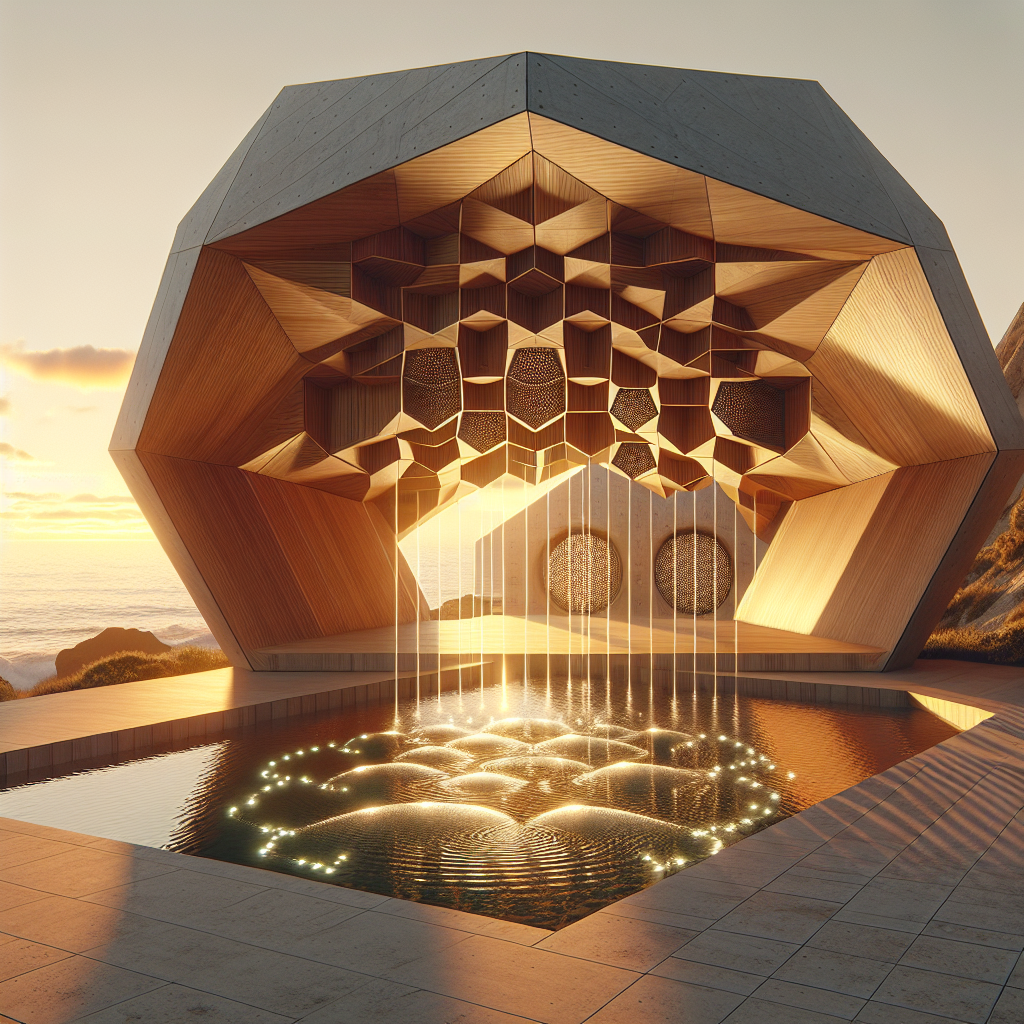
Perched on a coastal bluff north of Big Sur, the Resonant Pavilion by Atelier Satori exemplifies the union of geometry, sound, and nature. The pavilion’s twelve-sided form is clad in locally sourced cedar, its interior lined with concave panels of cast gypsum that act as natural amplifiers. Beneath the floor, a network of transducers emits low-frequency vibrations synchronized with ambient ocean sounds. Visitors recline on felt-lined benches as the space hums gently, blurring the line between architecture and instrument.
The project’s lead architect, Naomi Ishikawa, describes the design as “a dialogue between silence and resonance.” The polygonal geometry was chosen not for aesthetic novelty but for its acoustic neutrality—each facet reflecting sound evenly, eliminating echoes. The result is a space where every frequency feels intentional, every vibration deliberate. Ishikawa’s approach reflects a broader movement toward what she calls “acoustic minimalism”—design stripped of noise, both literal and conceptual.
From Private Sanctuaries to Public Installations
While many of these spaces exist as private retreats or boutique wellness centers, a growing number are emerging in public contexts. Urban planners are exploring how polygonal meditation pods and sound baths can be integrated into parks, airports, and libraries. These installations serve as micro-sanctuaries—accessible oases of calm within the city fabric. Their modular geometry allows for scalability and adaptability, echoing trends seen in modular design and sustainable urban planning.
In Singapore, the “Quiet Polygon” project has transformed disused underpasses into sound-activated meditation chambers. Each chamber responds to human presence with subtle tonal shifts, creating a participatory soundscape that evolves throughout the day. Such projects underscore a critical shift in design thinking: wellness is no longer confined to private luxury but is becoming a civic right, embedded in the urban experience.
The Future of Sonic Geometry
As technology and neuroscience continue to inform architectural practice, the integration of sound-responsive materials and adaptive geometries will deepen. Advances in neuroarchitecture suggest that environments tuned to specific frequencies can influence mood, focus, and even immune response. Architects are beginning to see sound not merely as an environmental factor but as a design material—fluid, sculptural, and profoundly human.
The next frontier lies in responsive architecture: spaces that sense the occupant’s physiological state and adjust acoustics, lighting, and temperature accordingly. Early prototypes of such systems are already being tested in wellness resorts and experimental pavilions. These innovations point toward a future where architecture is not static but symphonic—an active participant in human well-being.
Conclusion: Designing the Silence
The geometry of calm is not about absence but orchestration. Polygonal meditation spaces with integrated sound baths exemplify a new design ethos—one that values resonance over spectacle, introspection over impression. They remind us that architecture’s greatest power lies not in what it shows, but in what it allows us to feel. In a world increasingly defined by noise, these spaces offer something radical: the luxury of quiet, shaped by sound and geometry into pure experience.
For architects and designers, this movement signals a profound opportunity—to design not just for the eye, but for the entire sensory spectrum. As the boundaries between art, science, and spirituality blur, the future of spatial design may well be measured not in square meters, but in hertz.
Related reading: Explore how