
Sonic bubble installations: translucent spheres producing ambient music
Sonic Bubble Installations: Translucent Spheres Producing Ambient Music
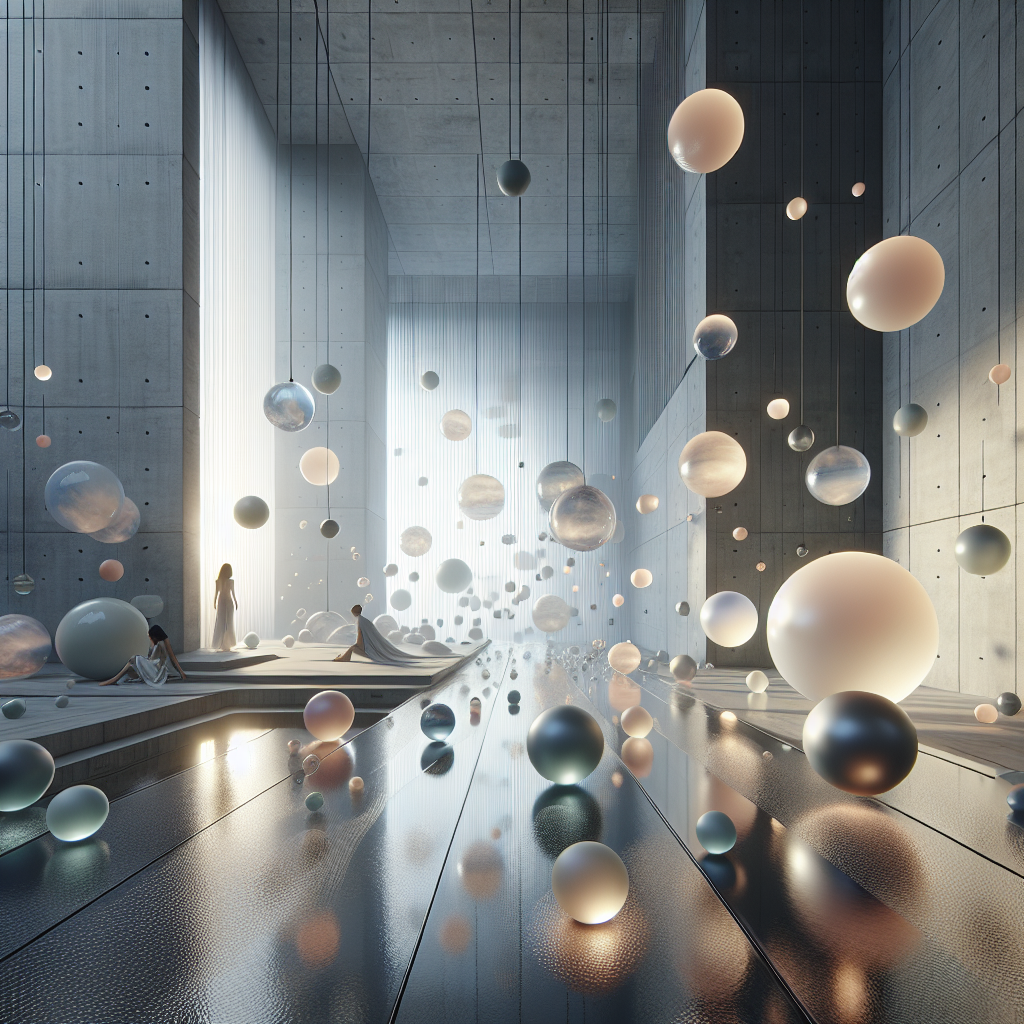
In the evolving landscape of experiential design, sonic bubble installations have emerged as a poetic intersection of sound, light, and spatial perception. These ethereal, translucent spheres—often suspended in clusters or scattered across architectural environments—generate ambient music that responds to movement, temperature, or even the rhythm of human breath. More than decorative objects, they are instruments of atmosphere, redefining how architecture engages the senses and how public and private spaces can evoke emotion through sound.
The Rise of Sonic Architecture
The idea of architecture as a resonant body is not new. From the domed acoustics of Byzantine cathedrals to the echoing vaults of Gothic cloisters, designers have long manipulated sound as a spatial material. Yet, the 21st century has brought a technological sophistication that allows sound to be generated, modulated, and spatially localized in real time. Sonic bubble installations are a natural evolution of this lineage—an embodiment of what some theorists now call “sonic architecture”.
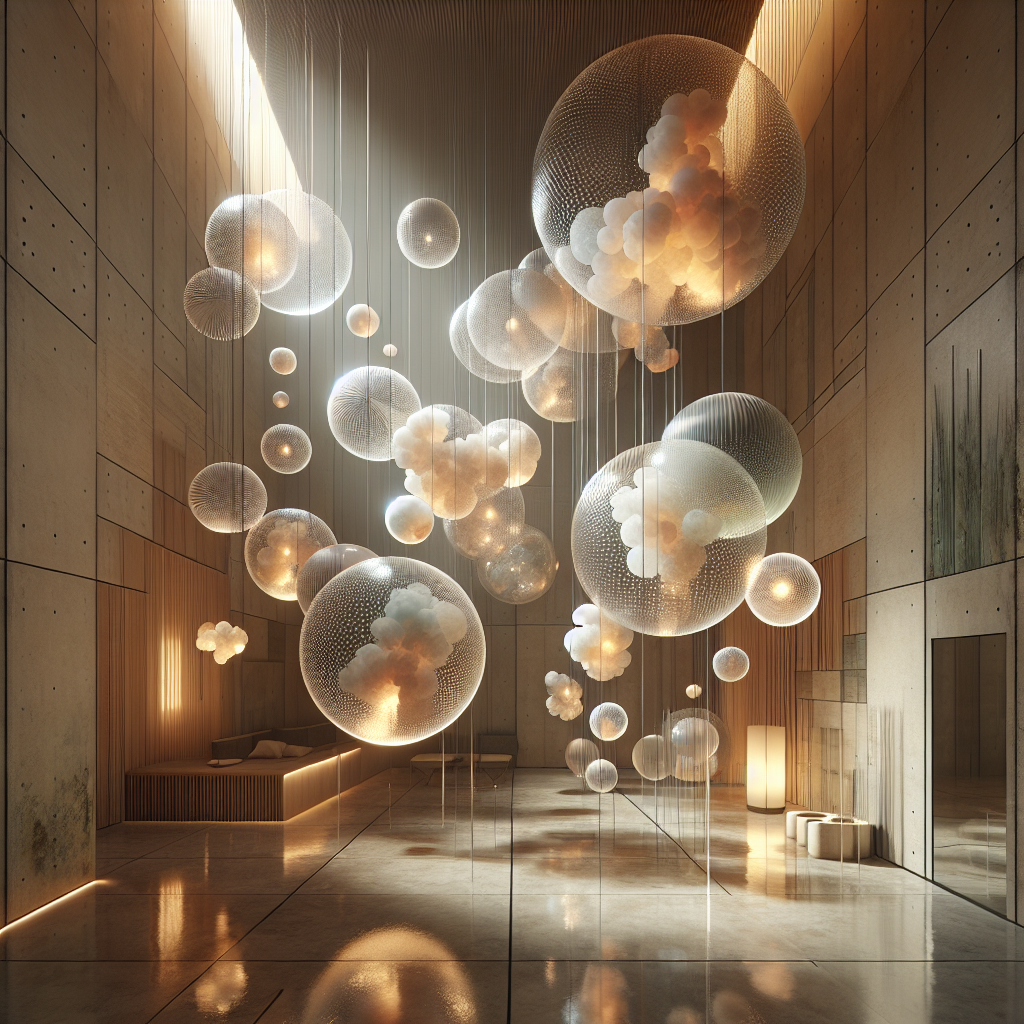
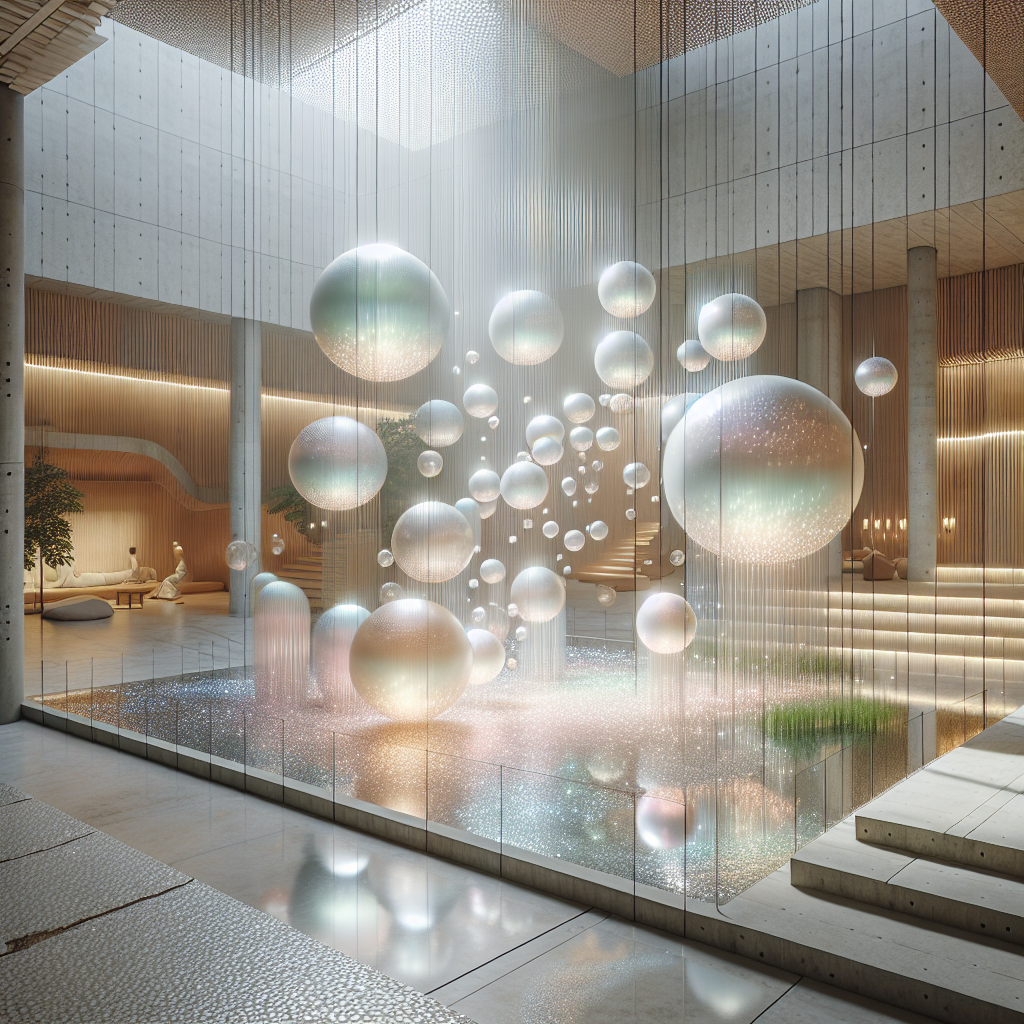
Each bubble acts as a semi-autonomous acoustic cell. Within its translucent membrane—crafted from polymer composites or glass infused with micro-resonators—tiny embedded transducers emit frequencies that blend into a continuous ambient composition. As visitors move through the installation, sensors detect proximity and adjust tonal layers, creating a responsive soundscape that feels alive. The result is a choreography of tone and translucency, a spatial symphony that blurs the boundary between art installation and architectural intervention.
Material Transparency and the Aesthetics of Lightness
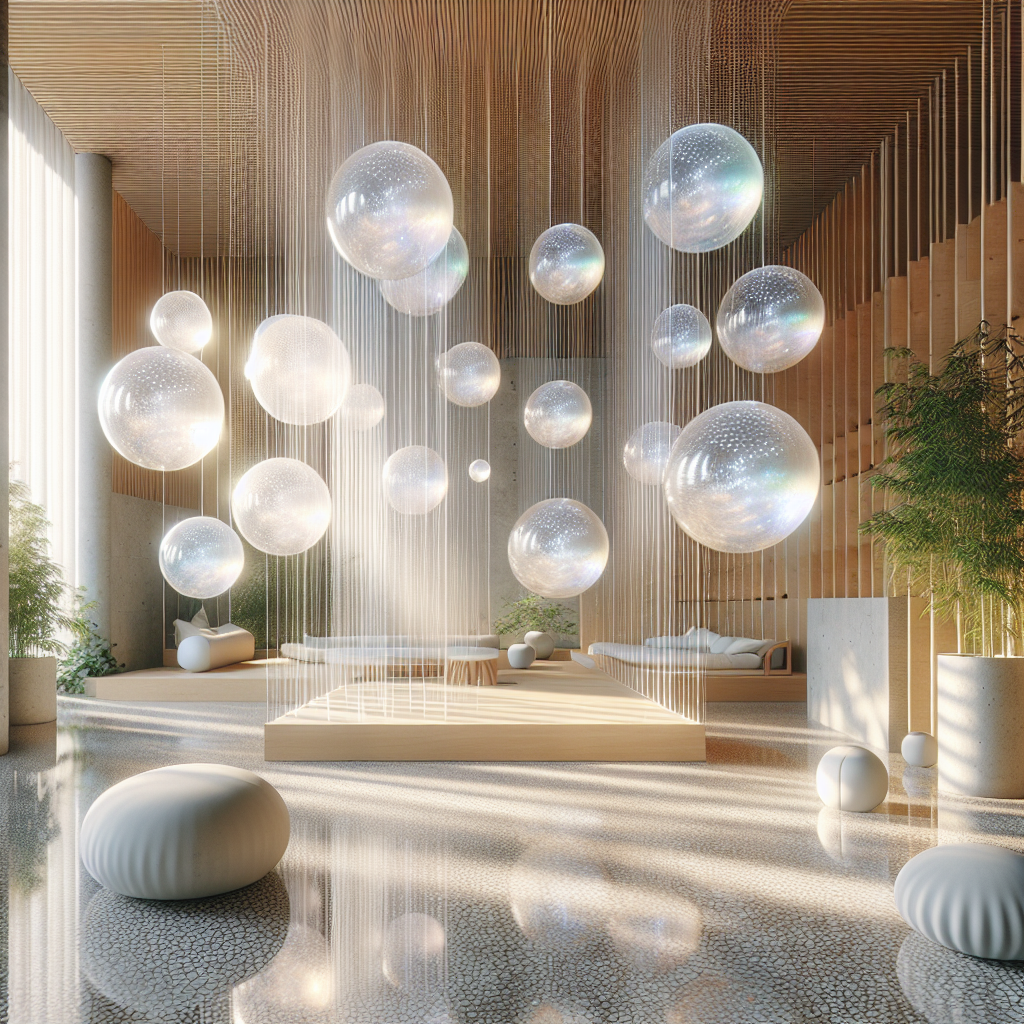
Visually, these installations evoke a sense of levitation. The bubbles, often ranging from 30 centimeters to two meters in diameter, are suspended by nearly invisible filaments or supported by thin carbon-fiber stems. When illuminated from within, they glow with a pearlescent shimmer, diffusing light across surrounding surfaces. The interplay of translucency and reflection transforms interiors into dreamlike environments—part laboratory, part sanctuary.
Designers are increasingly pairing these installations with biophilic design principles, integrating them into atriums, wellness centers, and hospitality spaces where sound and light are used to induce calm. The bubbles’ soft luminescence complements natural materials such as bamboo, linen, and terrazzo, while their acoustic properties subtly mask urban noise, enhancing acoustic comfort—a growing priority in contemporary interior design.
Sound as a Spatial Medium
At the core of sonic bubble installations lies the concept of sound spatialization—the art of positioning sound in three-dimensional space. Using advanced audio algorithms, designers can control how sound moves within a room, creating zones of intensity and silence. This technique draws from the same principles that shape spatial audio in virtual reality environments, yet here it manifests physically, inviting tactile and emotional engagement.
In practice, the ambient compositions emitted by these spheres are rarely melodic. Instead, they rely on tonal gradients, harmonic drones, and field recordings—sonic textures that evoke the natural world. The goal is not to entertain but to envelop. As one approaches a cluster of bubbles, the sound may deepen, like entering a pocket of still air; step away, and the tones dissolve into the ambient hum of the space. The installation becomes a living organism, continuously adapting to its environment and its audience.
Case Studies: Immersive Resonance in Practice
Several recent projects exemplify the potential of sonic bubble installations to transform architectural experience. At the 2025 Venice Architecture Biennale, a collective of Scandinavian designers unveiled “Aural Drift,” a pavilion filled with suspended glass spheres that emitted sounds derived from Arctic wind recordings. The installation’s subtle oscillations mirrored the ebb and flow of natural forces, offering visitors a meditative refuge amid the bustle of the exhibition.
In Tokyo, the interdisciplinary studio HAKU created “Sora Bubbles,” a permanent installation in a luxury hotel lobby. Here, the spheres are integrated into the HVAC system, allowing airflow to subtly vibrate their membranes. The resulting tones shift with temperature and humidity, producing an ever-changing ambient microclimate of sound. Guests describe the experience as “walking through a living cloud.”
Meanwhile, in London, a collaboration between sound artist Yuri Matsuda and the architectural firm Atelier Liminal explored the therapeutic potential of sonic bubbles in healthcare environments. Their installation, “Breathspace,” uses biometric sensors to synchronize sound output with visitors’ breathing patterns, encouraging slow, mindful respiration. Early studies suggest measurable reductions in stress levels among participants—a finding that aligns with growing research into the physiological benefits of sound therapy.
Technology and Craft: The Invisible Orchestra
Behind the ethereal beauty of these installations lies a complex orchestration of technology. Each sphere houses a microcontroller, a piezoelectric speaker, and a set of sensors—infrared, ultrasonic, or motion-based—networked through wireless protocols. The system runs on low-voltage power, often supplemented by solar or kinetic energy sources, aligning with the broader movement toward net-zero design practices.
Material innovation plays an equally crucial role. Designers are experimenting with bio-based polymers and recycled glass composites to reduce environmental impact. Some prototypes even use aerogel—a material known for its exceptional lightness and insulation—to achieve near-weightless forms. The craftsmanship involved in shaping these delicate membranes recalls the precision of glassblowing or the finesse of textile weaving, bridging digital fabrication with artisanal tradition.
Acoustic Ecology and Emotional Design
As urban environments grow denser and noisier, the need for acoustic sanctuaries becomes more pressing. Sonic bubble installations respond to this challenge not by silencing the city but by reinterpreting its soundscape. They invite a form of listening that is active yet restful, transforming noise into texture, chaos into rhythm. This approach resonates with the principles of acoustic ecology, which advocates for the preservation and design of healthy sonic environments.
From a psychological perspective, these installations tap into the emerging field of emotional design. By integrating sound as a sensory layer, architects can influence mood, perception, and even behavior. In retail settings, for instance, subtle ambient tones can encourage slower movement and deeper engagement with products. In workplaces, they can foster focus and reduce cognitive fatigue. The potential applications extend far beyond the gallery or museum, suggesting a future where sound becomes as integral to design as light or texture.
Future Directions: Toward Multi-Sensory Architecture
The proliferation of sonic bubble installations signals a broader shift toward multi-sensory architecture—spaces that engage not only sight but also hearing, touch, and even smell. As designers explore new ways to integrate sensory technologies, the boundaries between architecture, art, and performance continue to blur. Projects like these align with the growing interest in interactive installations that transform passive spectators into active participants.
Looking ahead, advancements in AI-driven sound synthesis and responsive materials will likely make these installations more adaptive and personalized. Imagine a residential interior where sonic bubbles adjust their tonal palette to your circadian rhythm, or a public plaza where the collective footsteps of pedestrians compose a daily symphony. Such visions are not far from reality; they represent the next chapter in the dialogue between design and emotion.
A Symphony of Space and Silence
Ultimately, sonic bubble installations invite us to reconsider what architecture can be. They are not structures in the traditional sense but atmospheres—fleeting, fluid, and profoundly human. By merging the tangible and the intangible, they transform space into experience, sound into structure, and silence into art. In doing so, they remind us that the future of design may not lie in building more, but in tuning what already exists—one resonant bubble at a time.
For professionals and enthusiasts alike, these installations represent a frontier where technology meets poetics, and where architecture listens as much as it speaks. They are the embodiment of a new design ethos: one that values immersion, serenity, and sensory balance in an increasingly overstimulated world.
Keywords: sonic bubble installations, ambient music design, sonic architecture, acoustic design, sensory architecture, translucent spheres, interactive installations, sound-responsive design