Silence Architecture: Designing Spaces for Absolute Noise Cancellation
In an age where the hum of technology, the drone of traffic, and the murmur of urban life form an omnipresent soundtrack, silence has become a luxury. Architects and designers are now turning their attention to a new frontier—Silence Architecture—a discipline that explores how built environments can actively cancel noise, creating sanctuaries of stillness in an increasingly cacophonous world.
The Science of Silence
Silence Architecture is not merely about insulation or thick walls; it’s about the orchestration of sound. The field draws from acoustic engineering, psychoacoustics, and material science to shape spaces that neutralize, absorb, or redirect sound waves. The goal is not total muteness but a balanced acoustic ecology—a space where sound behaves intentionally.
Recent studies from the Journal of the Acoustical Society of America reveal that the human brain’s stress response decreases significantly in environments with consistent low-decibel soundscapes. This has led to a surge in architectural projects that prioritize auditory wellness alongside visual and thermal comfort.
Architectural Strategies for Noise Cancellation
Traditional soundproofing relies on mass and density—thick concrete, layered drywall, and sealed glazing. But the new wave of silence-oriented design employs active acoustic control. Through embedded sensors and adaptive materials, buildings can now “listen” and respond to their sonic environment.
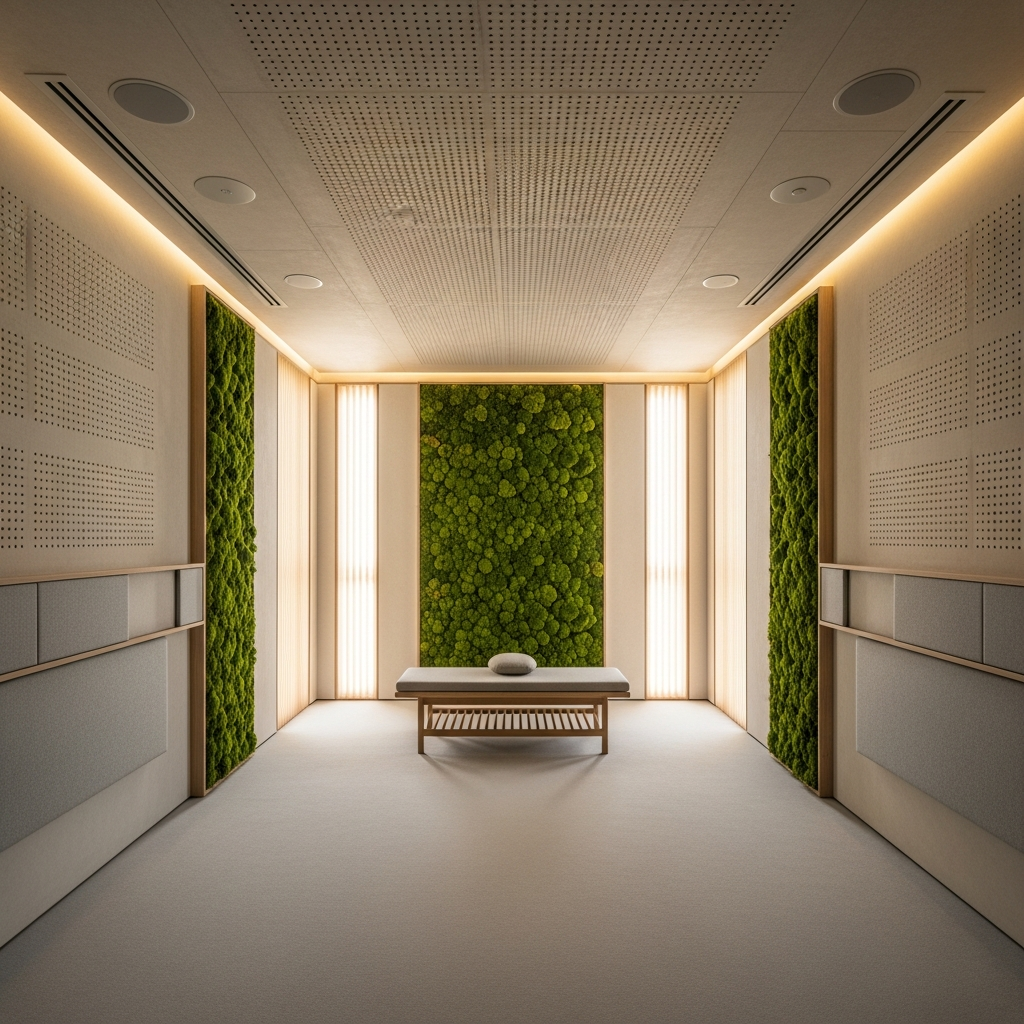
For instance, parametric wall panels designed with micro-perforations can absorb specific frequencies, while active noise-cancellation systems—akin to those in high-end headphones—emit counter-waves to neutralize ambient noise. The result is a spatial equilibrium, where sound is not eliminated but harmonized.
In some experimental offices, designers are combining these systems with biophilic elements. As explored in biophilic design, natural materials like cork, moss, and bamboo not only improve air quality but also diffuse sound, creating a soft, organic acoustic profile. The tactile and auditory calm these materials provide reinforces the psychological benefits of silence.
Material Innovations: The Texture of Quiet
Material science is redefining how silence feels. Porous ceramics, recycled felt composites, and nano-fiber membranes are now being integrated into architectural surfaces. These materials don’t just block sound—they sculpt it. The Material District has catalogued hundreds of such innovations, many of which are biodegradable or recyclable, aligning acoustic comfort with sustainability.
In residential architecture, the trend manifests as “soft minimalism”: interiors dominated by matte finishes, layered textiles, and rounded geometries that absorb rather than reflect sound. In contrast, public spaces like libraries and wellness centers are experimenting with “sonic zoning,” where acoustic boundaries are defined by material shifts rather than physical partitions.
Urban Silence: Designing the Quiet City
Silence Architecture extends beyond interiors. Urban planners are beginning to view noise as a form of pollution—one that requires systemic mitigation. Sound barriers are being reimagined as sculptural installations, and green corridors are doubling as acoustic buffers. The concept of the “quiet city” envisions an urban fabric where transportation, vegetation, and architecture collaborate to create sonic balance.
Projects inspired by net-zero design principles are integrating acoustic optimization into sustainability frameworks. Green roofs, for example, do more than insulate—they absorb vibrations and reduce sound reflection. Similarly, wooden skyscrapers, as explored in timber high-rise construction, offer natural damping properties that contribute to quieter interiors.
Case Studies: Spaces of Sonic Serenity
In Copenhagen, the “Silent Library” by Studio Vang uses an algorithmic layout to disperse sound evenly across reading zones. Its walls are lined with micro-fiber panels that adjust porosity based on decibel levels. Meanwhile, in Tokyo, the “Hush Capsule Hotel” employs sound-cancelling pods, each tuned to counteract the city’s low-frequency rumble. These projects demonstrate how silence can be engineered as an architectural experience rather than a byproduct.
Corporate environments are also embracing the movement. Tech campuses are experimenting with “cocoon offices,” where employees can retreat into sound-neutral microspaces. These pods are equipped with active acoustic membranes that adapt to speech patterns, ensuring privacy without isolation.
The Emotional Architecture of Quiet
Silence is not the absence of sound—it’s the presence of calm. Neuroscientists have found that quiet environments enhance cognitive function, creativity, and emotional regulation. This insight is transforming the way architects approach wellness design. Silence is now being treated as a material in itself—something to be shaped, layered, and curated.
Architectural theorists often compare the pursuit of silence to the minimalist ethos of Mies van der Rohe: the idea that less can indeed be more. But in this context, “less” refers not to form but to sensory input. A well-designed silent space invites introspection, amplifying the subtleties of light, texture, and time.
Future Horizons: The Sonic Ethics of Design
As urban density increases, the right to silence may soon become a matter of public health. Institutions like the World Health Organization already classify chronic noise exposure as a major environmental hazard. Architects, therefore, bear a new ethical responsibility: to design not only for visibility and sustainability but also for audibility—or rather, its absence.
Silence Architecture challenges the industry to rethink the sensory hierarchy of design. It asks: what if the most luxurious space is not the one that dazzles the eye, but the one that soothes the ear? As cities grow louder, the architecture of quiet may become the most radical form of progress.
{
  "seo_title": "Silence Architecture: Spaces of Absolute Calm",
  "meta_description": "Explore Silence Architecture and how designers create spaces for absolute noise cancellation using advanced materials and acoustic innovation.",
  "excerpt": "Can architecture design silence? Discover how acoustic innovation and material science are redefining serenity through Silence Architecture.",
  "focus_keyphrase": "Silence Architecture"
}
AI Image Prompts
Prompt: Photorealistic image of a minimalist meditation room with soft acoustic panels, diffused natural light, and matte concrete surfaces, shot on a Hasselblad H6D, ultra-high resolution. Alt text: Minimalist meditation room designed for silence with acoustic panels and soft lighting. Caption: A sanctuary of stillness—where architecture and acoustics converge to create restorative quiet.
Prompt: Photorealistic urban park surrounded by sound-absorbing green walls and timber pathways, captured at dawn with soft fog, Hasselblad medium format. Alt text: Urban park with acoustic green walls creating a quiet zone in the city. Caption: The city’s lungs—and its ears—protected by layers of vegetation and design ingenuity.
Prompt: Interior of a futuristic office pod with adaptive acoustic membranes and biophilic textures, natural daylight filtering through frosted glass, Hasselblad 907X. Alt text: Acoustic office pod integrating noise-cancelling technology and natural materials. Caption: Workspaces that listen—acoustic intelligence woven into every surface.
Prompt: Photorealistic image of a timber high-rise interior with suspended acoustic baffles and moss walls, warm ambient lighting, shot on Hasselblad X2D. Alt text: Timber high-rise interior featuring acoustic baffles and moss walls for noise reduction. Caption: Nature’s hush meets vertical innovation in a new era of sustainable silence.
Social Media Strategy
Instagram
Main Post Caption: What does silence look like? Discover how architects are crafting spaces that cancel noise and restore calm. Step inside the world of Silence Architecture—where sound becomes design. 🌿🔇 #DesignForCalm
To provide the best experiences, we use technologies like cookies to store and/or access device information. Consenting to these technologies will allow us to process data such as browsing behavior or unique IDs on this site. Not consenting or withdrawing consent, may adversely affect certain features and functions.
Functional
Always active
The technical storage or access is strictly necessary for the legitimate purpose of enabling the use of a specific service explicitly requested by the subscriber or user, or for the sole purpose of carrying out the transmission of a communication over an electronic communications network.
Preferences
The technical storage or access is necessary for the legitimate purpose of storing preferences that are not requested by the subscriber or user.
Statistics
The technical storage or access that is used exclusively for statistical purposes.The technical storage or access that is used exclusively for anonymous statistical purposes. Without a subpoena, voluntary compliance on the part of your Internet Service Provider, or additional records from a third party, information stored or retrieved for this purpose alone cannot usually be used to identify you.
Marketing
The technical storage or access is required to create user profiles to send advertising, or to track the user on a website or across several websites for similar marketing purposes.