
Post-Human Comfort: Designing Furniture for Bodies That Don’t Exist Yet
Post-Human Comfort: Designing Furniture for Bodies That Don’t Exist Yet
In the evolving landscape of design, the concept of comfort is being redefined. No longer confined to the ergonomics of the human body as we know it, the next frontier of furniture design imagines a world where the body itself is mutable—augmented, hybridized, or even entirely digital. “Post-human comfort” is not a rejection of humanity but an expansion of it, a design philosophy that anticipates new anatomies, new modes of perception, and new relationships between form, function, and consciousness.
The End of Anthropocentrism in Design
For centuries, furniture has been designed around the proportions of the human body—our reach, our posture, our need for rest. But as biotechnology, robotics, and neural interfaces advance, the boundaries of what constitutes a “body” are dissolving. Designers are beginning to ask: what happens when the sitter is not entirely human? When limbs are augmented, or when consciousness occupies multiple environments simultaneously—physical and virtual?
This shift mirrors broader transformations in architecture and urbanism. Just as futuristic city design has moved beyond human-scale planning to accommodate autonomous systems and AI-driven infrastructure, furniture design is beginning to accommodate the post-human condition. The chair, the table, the bed—these archetypes are being reimagined not as static objects but as adaptive interfaces between organic and synthetic life.
Designing for Fluid Bodies
Imagine a chair that senses the micro-adjustments of a cybernetic spine, or a table that calibrates its height to the neural impulses of a user’s prosthetic limbs. The next generation of comfort will not rely on cushions or curves but on responsive systems that anticipate the user’s physiological and emotional state. Research from the Architects’ Journal and the MIT Media Lab suggests that the integration of biofeedback sensors into furniture could create environments that “learn” the body’s needs over time.
Such adaptability recalls the principles of responsive design in architecture, where spaces shift in real time to accommodate environmental or behavioral changes. In a post-human context, this responsiveness becomes intimate—furniture that breathes with us, that modulates temperature, texture, and support based on biological rhythms or emotional cues.
Material Intelligence
Material science is at the heart of this transformation. Self-healing polymers, shape-memory alloys, and bioengineered textiles are enabling designers to create furniture that behaves more like living tissue than inert matter. According to a 2025 study in the Materials & Design journal, these “smart materials” can sense, respond, and even repair themselves, paving the way for objects that evolve alongside their users.
Consider the implications: a recliner that stiffens for spinal support during long hours of VR immersion, or a sofa that adjusts its density to mimic the sensation of weightlessness for augmented-reality experiences. Comfort becomes dynamic, not fixed—a dialogue between user and object, mediated by data and material intelligence.
Virtual Bodies, Virtual Comfort
As our lives increasingly unfold in digital spaces, the notion of comfort extends beyond the physical. Designers are exploring how to translate tactile sensations into virtual environments, creating “haptic furniture” that bridges the sensory gap between real and simulated worlds. Projects emerging from the Bartlett School of Architecture’s Interactive Architecture Lab, for instance, explore how motion, vibration, and temperature feedback can simulate presence and intimacy in virtual space.
This hybridization echoes the ideas explored in virtual reality in architecture, where designers use immersive tools not only to visualize space but to inhabit it. In the post-human home, furniture may exist simultaneously in multiple realities—its physical form minimal, its digital twin infinitely mutable.
From Object to Organism
Perhaps the most radical shift is philosophical. Post-human furniture challenges the very distinction between object and organism. As AI and synthetic biology converge, furniture could become semi-autonomous—learning, adapting, even reproducing. The idea may sound speculative, but it aligns with current research in biomimicry, where natural systems inspire self-regulating, energy-efficient design.
Imagine a desk that grows new surfaces as your workspace expands, or a bed that alters its texture to promote specific sleep cycles. These are not mere conveniences—they represent a new kind of symbiosis between human and non-human intelligence. Comfort, in this sense, becomes ecological: a negotiation between species, systems, and data streams.
Ethics of the Post-Human Home
With such possibilities come profound ethical questions. Who owns the data generated by a sentient chair? How do we define consent when our furniture monitors our biometrics? The Royal Institute of British Architects (RIBA) has begun to address these concerns, urging designers to consider privacy, autonomy, and sustainability as integral to the post-human design process.
Moreover, the environmental implications are significant. As we move toward adaptive, tech-embedded furniture, the challenge will be to balance innovation with circularity. Initiatives like zero-waste design offer a blueprint for creating intelligent objects that are also biodegradable, modular, and repairable. The future of comfort must be as sustainable as it is sophisticated.
Reimagining the Domestic Landscape
In the post-human home, the living room may no longer be a static arrangement of sofas and tables but a fluid ecosystem of responsive surfaces. Walls may flex to cradle the body, lighting may adjust to neural activity, and furniture may morph to accommodate multiple modes of being—sitting, floating, meditating, or existing in augmented states.
These ideas are not distant fantasies. Designers like Neri Oxman and firms such as UNStudio are already exploring “material ecologies” and responsive interiors that anticipate post-human ergonomics. The home becomes a living interface—a habitat that learns, evolves, and coexists with its inhabitants in ways that blur the line between biology and design.
Conclusion: Comfort Beyond the Human
“Post-human comfort” is not about abandoning the human form but about expanding its possibilities. It invites designers to think beyond the familiar—to imagine furniture not as passive support but as active collaboration. As our bodies, technologies, and environments become increasingly intertwined, the furniture of the future will not simply serve us; it will know us, adapt to us, and perhaps even dream with us.
In this new paradigm, comfort is no longer a static state but a living process—an evolving choreography between flesh, fabric, and code.
—{
"seo_title": "Post-Human Comfort in Future Furniture Design",
"meta_description": "Explore post-human comfort and how future furniture design adapts to evolving bodies and digital lifestyles.",
"excerpt": "What will comfort mean when our bodies evolve beyond biology? Explore how post-human furniture design redefines the relationship between body and object.",
"focus_keyphrase": "post-human comfort"
}
AI Image Prompts
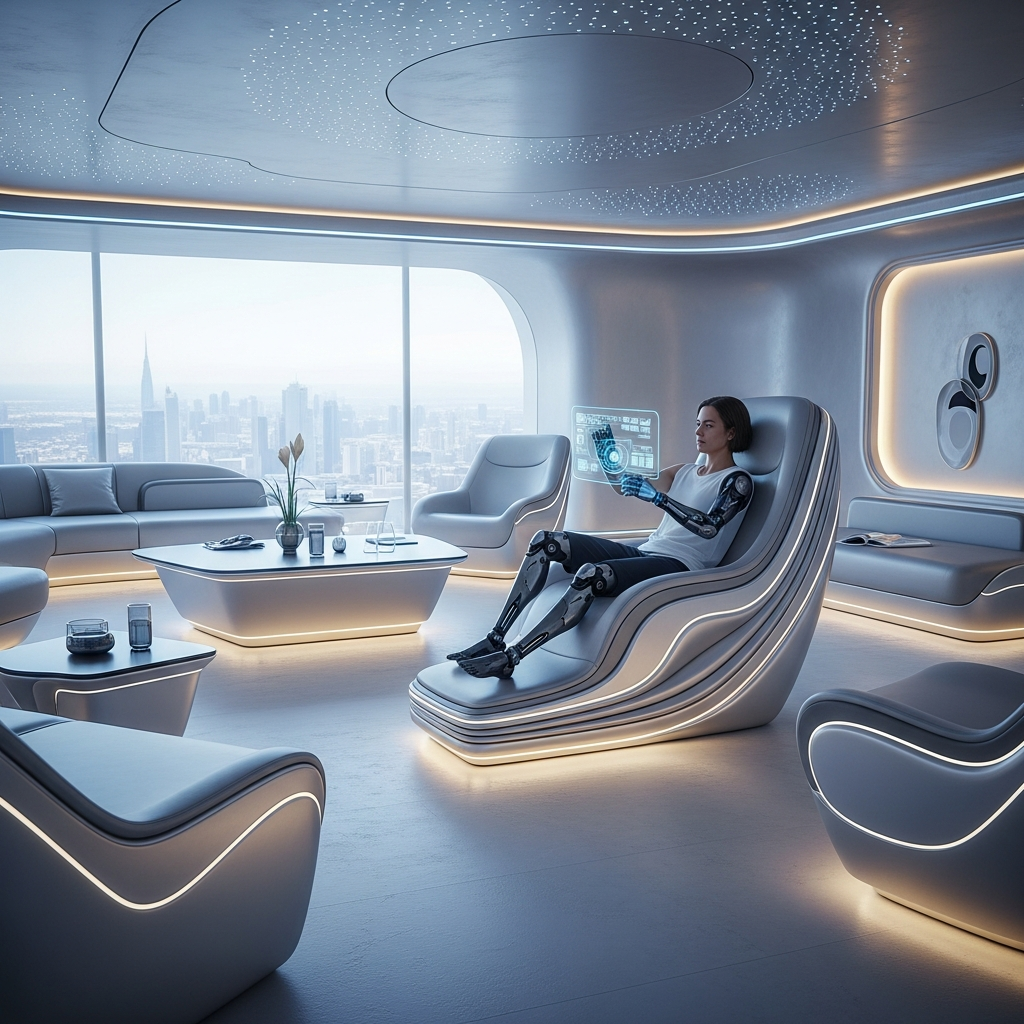
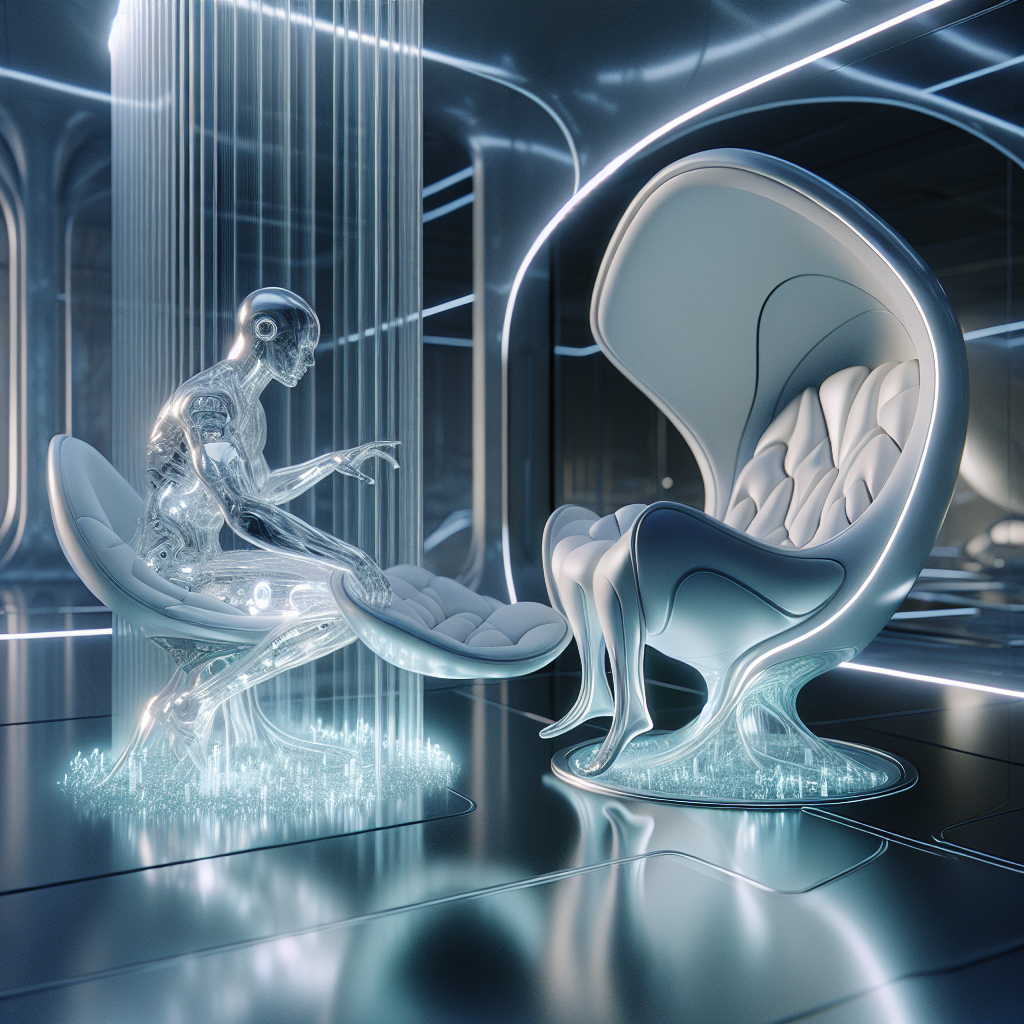
- Prompt: Photorealistic image of a futuristic living room with adaptive furniture that changes shape to fit a hybrid human-cybernetic body, shot on a Hasselblad H6D, natural soft lighting, minimalist palette of silver and ivory.
Alt text: Adaptive post-human furniture in a futuristic living room.
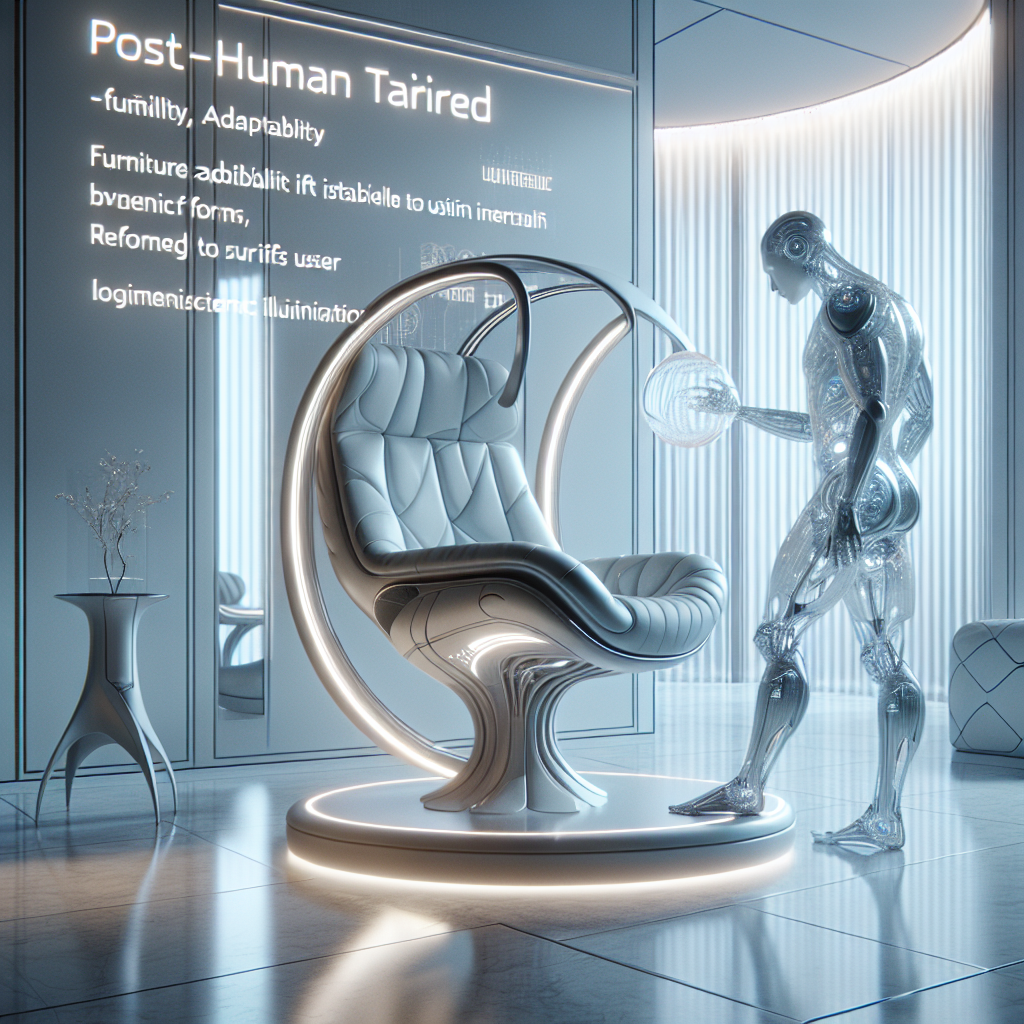
Caption: A vision of the post-human home—where furniture molds itself to the body’s evolving form. - Prompt: Close-up of a smart chair with embedded bio-sensors glowing faintly, surrounded by translucent materials and holographic controls, Hasselblad macro lens, cinematic lighting.
Alt text: Smart chair with bio-sensors for adaptive comfort.
Caption: The chair of tomorrow senses not just posture but emotion. - Prompt: A serene bedroom featuring a responsive bed that shifts texture and temperature, bioluminescent walls, photographed with a Hasselblad X2D, twilight ambience.
Alt text: Responsive bed in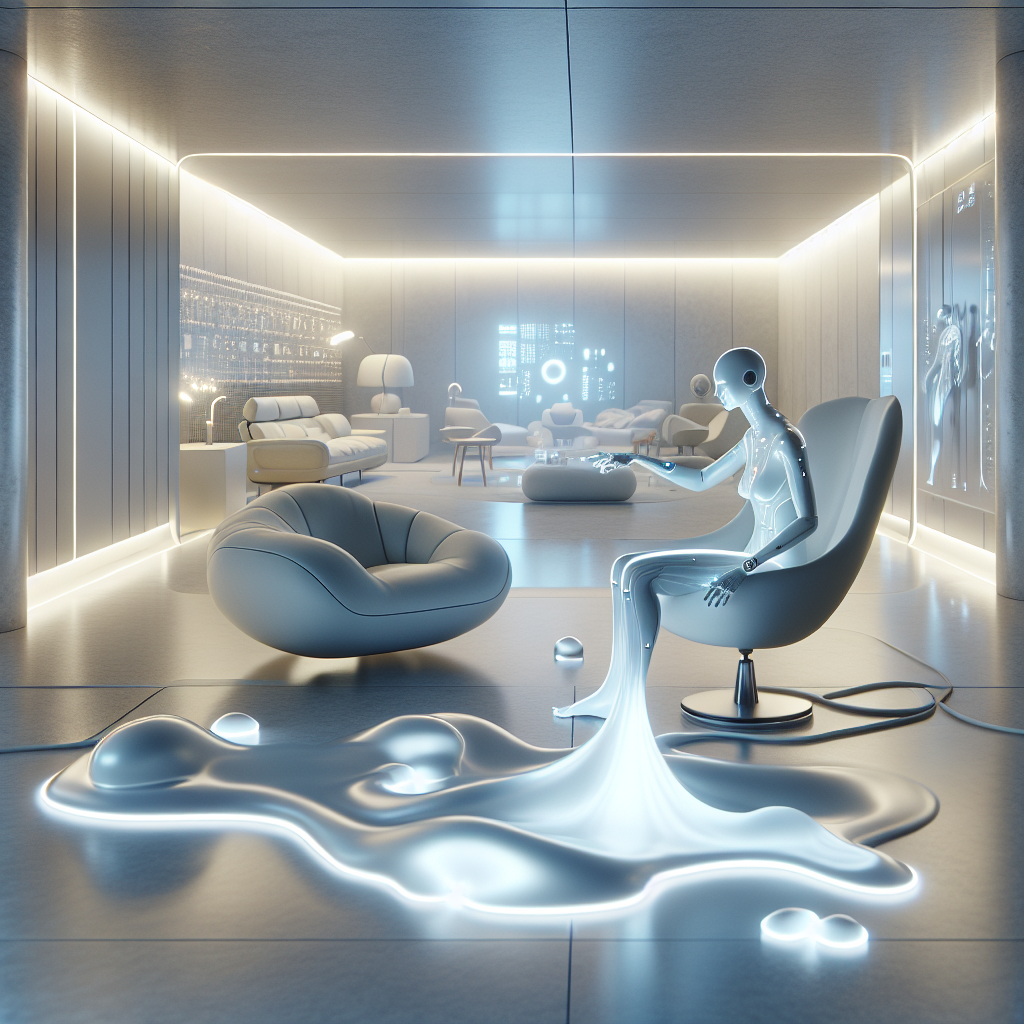
 ×
×❮ ❯