
Nomadic offices collapsible: work pods for mobile professionals

Nomadic Offices Collapsible: Work Pods for Mobile Professionals
In a world where mobility and flexibility have become the new cornerstones of professional life, the traditional office is dissolving into a more fluid, adaptive concept. Enter the nomadic office—a collapsible, transportable workspace designed for the mobile professional. These work pods are not merely portable offices; they are architectural statements that encapsulate the evolving relationship between design, technology, and human productivity. As hybrid work becomes a global norm, these modular sanctuaries are redefining what it means to “go to work.”
The Rise of the Nomadic Professional
Over the past decade, the global workforce has undergone a seismic shift. According to a 2025 report by the International Labour Organization, more than 35% of professionals worldwide now identify as digital nomads or remote workers. This new class of professionals demands spaces that are as dynamic as their lifestyles—spaces that can unfold in a forest clearing, a rooftop terrace, or the corner of a co-working hub. The collapsible office pod responds to this demand with a blend of architectural ingenuity and minimalist precision.
Architects and designers are reimagining the workplace as a movable habitat, echoing the adaptability of nomadic cultures. The concept aligns with the growing interest in modular design and the sustainability-driven ethos that has come to define contemporary architecture.
Design Philosophy: Compactness Meets Comfort
At the heart of the collapsible office movement lies a profound design challenge: how to condense the functionality of a full-scale office into a structure that can be folded, transported, and reassembled within hours. The solution often lies in transformative geometry—panels that hinge, walls that telescope, and furniture that morphs from desk to storage unit with a single gesture.
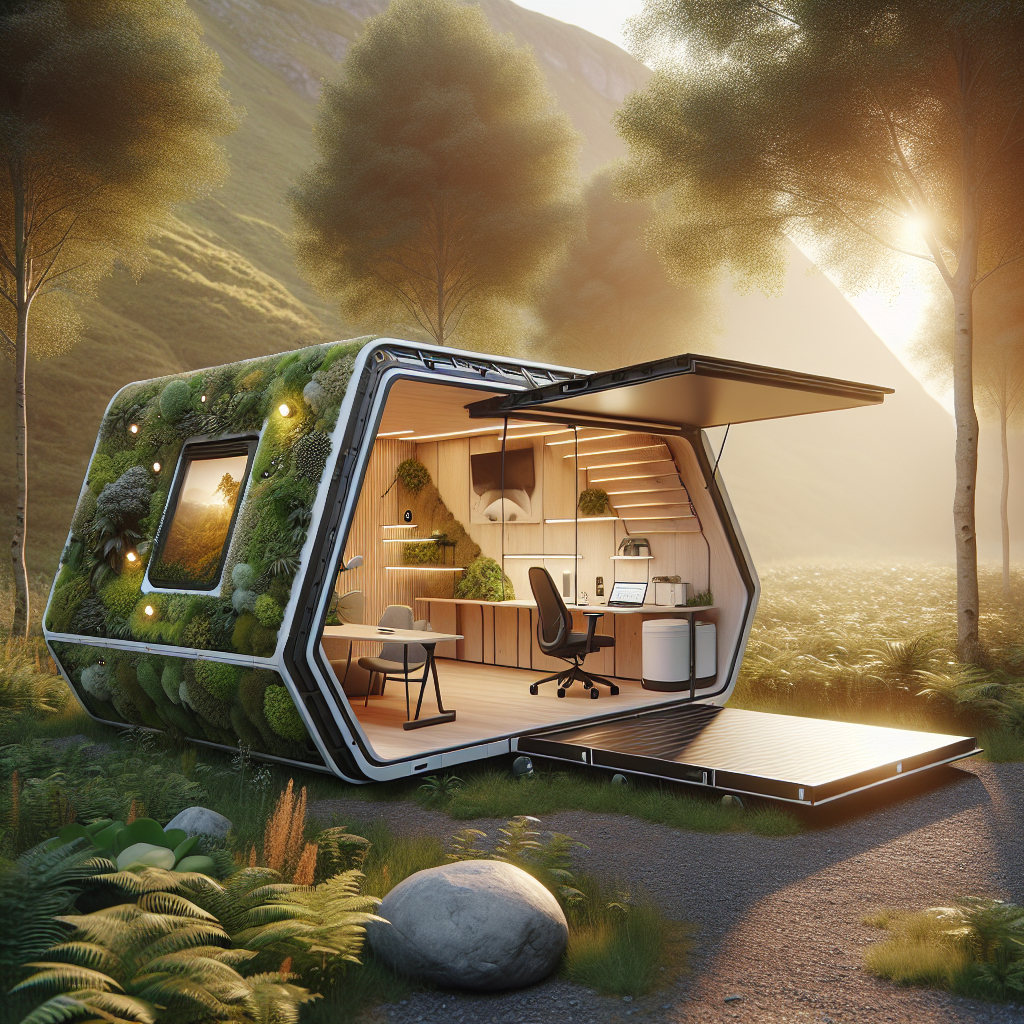
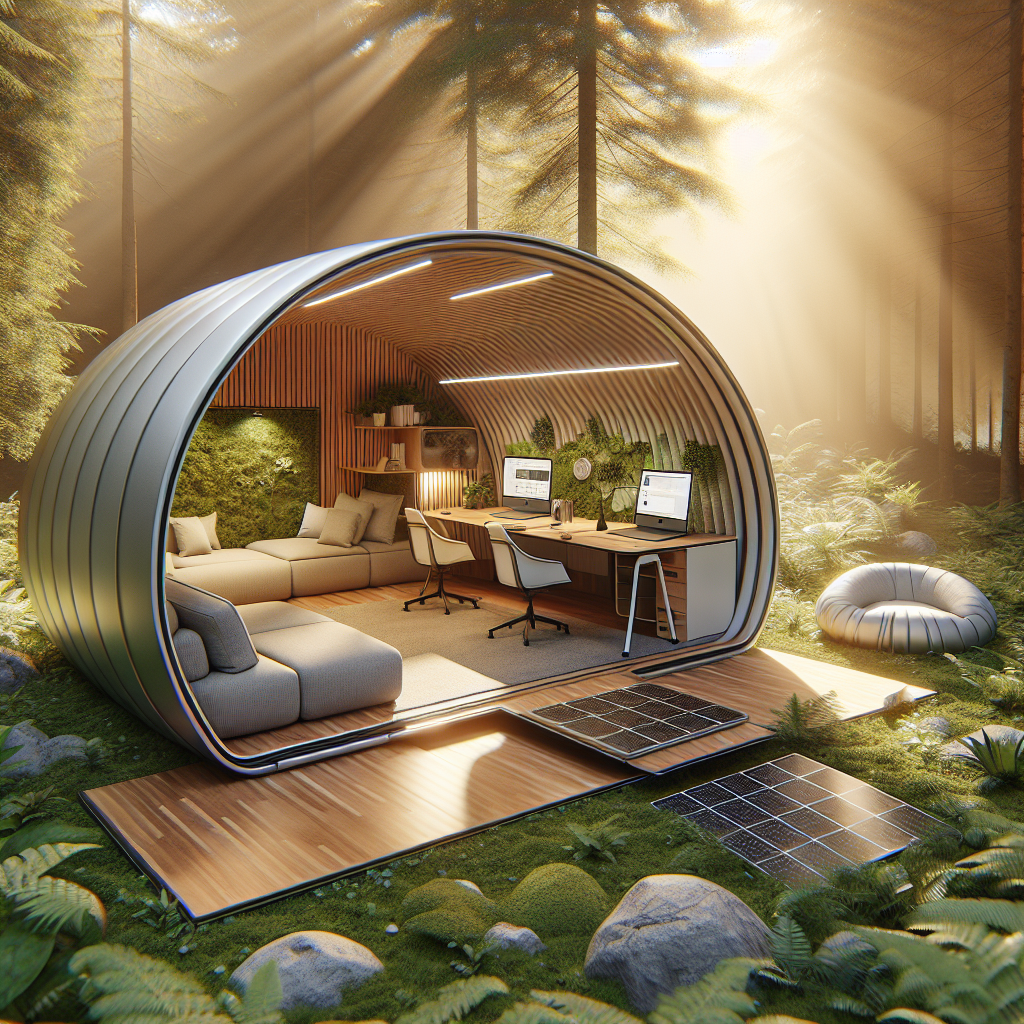
These pods often employ lightweight composite materials such as carbon fiber, recycled aluminum, and laminated bamboo, ensuring both portability and durability. The interiors are designed with a tactile sensitivity that mirrors the serenity of minimalist Japanese teahouses: soft acoustic panels to absorb sound, diffused skylights to enhance natural illumination, and biophilic elements—miniature moss walls or potted succulents—to maintain a psychological connection to nature. This approach resonates deeply with the principles of biophilic design, which emphasizes the restorative power of natural environments.
Engineering Portability: The Art of Collapse
The architectural innovation behind collapsible work pods lies in their mechanical intelligence. Much like the origami structures that inspire them, these pods rely on precision folding systems and tension-based frameworks. Designers such as Atelier Nomade and Studio Aether have developed pods that can be compacted into a flat-pack format and transported via standard cargo vans or even bicycles equipped with modular trailers.
One notable example is the “FoldHaus Office,” a solar-powered unit that expands from a 2-square-meter box into a 12-square-meter workspace in under ten minutes. Its kinetic façade panels double as shading devices, adapting to light conditions throughout the day. The structure’s energy autonomy—achieved through integrated photovoltaic membranes—positions it within the same sustainable lineage as solar-powered architecture.
Human-Centric Functionality
Beyond the mechanical and aesthetic sophistication, the true success of a nomadic office lies in its ability to support human well-being. The best designs balance technological integration with sensory comfort. Many pods now include adaptive lighting systems that mimic circadian rhythms, ergonomic furniture crafted from recycled materials, and embedded air purification modules that maintain optimal indoor air quality.
Some designers are even exploring AI-assisted environmental controls—systems that learn user preferences and adjust temperature, lighting, and acoustics accordingly. This convergence of architecture and artificial intelligence echoes the broader trends explored in AI in architecture, where built environments evolve responsively to human behavior.
Material Innovation and Sustainability
Material selection plays a pivotal role in the success of collapsible work pods. Many contemporary prototypes utilize biodegradable composites or reclaimed materials, reflecting a commitment to circular design principles. According to the World Green Building Council, construction and building operations account for nearly 40% of global carbon emissions. By employing recyclable aluminum frames, hemp-based insulation, and modular joints designed for disassembly, these pods significantly reduce environmental impact.
Some models even integrate self-healing polymers that repair micro-cracks autonomously, extending product lifespan and minimizing waste. This philosophy aligns with the growing movement toward zero-waste architecture, where durability and adaptability are prioritized over disposability.
Case Studies: From Desert to City Rooftop
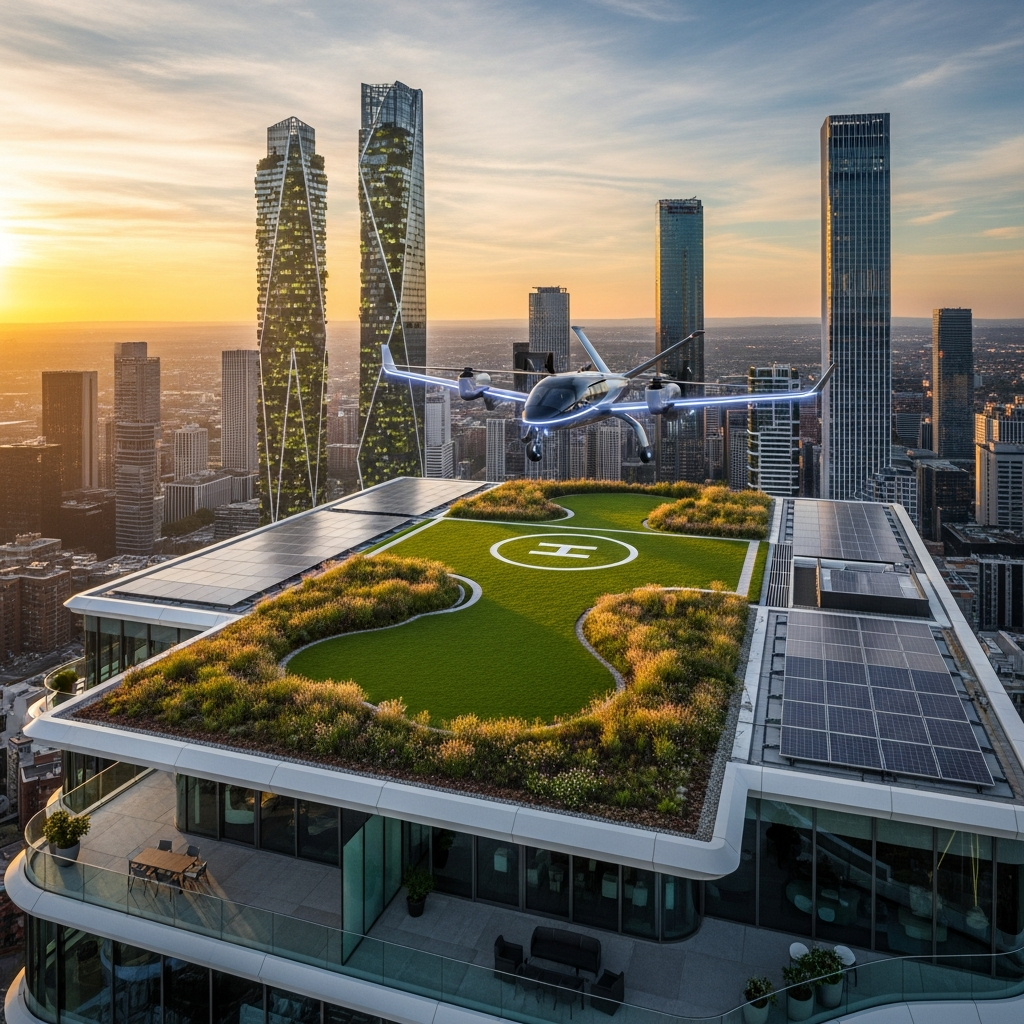
Across the globe, several pioneering projects are redefining the potential of collapsible workspaces. In the Moroccan desert, Studio Oualalou + Choi’s “Nomad Pavilion” offers a deployable workspace for researchers and artists, featuring a tensile fabric roof that filters sunlight into a soft amber glow. In contrast, the “Urban Cocoon” by Berlin-based designer Lara Kopp transforms disused rooftops into temporary offices, its reflective shell blending seamlessly into the skyline.
These projects demonstrate the adaptability of the typology: from off-grid retreats to urban micro-offices, the collapsible pod becomes a vessel for creative autonomy. Its presence in both natural and metropolitan contexts underscores the growing desire for spatial independence—a freedom to choose where and how one works.
Economic and Cultural Implications
The rise of nomadic offices also signals a broader cultural shift. The workspace is no longer a fixed location but a state of mind. For companies, this flexibility translates into reduced overhead costs and access to a more geographically diverse talent pool. For individuals, it offers a renewed sense of agency—an ability to design one’s environment in harmony with personal rhythms and landscapes.
In architectural terms, this movement parallels the evolution of adaptive reuse, where existing spaces are reimagined for new functions. The collapsible pod takes this ethos further, suggesting that architecture itself can be impermanent, responsive, and nomadic.
The Future of Workspaces: Mobility as a Mindset
As we approach the late 2020s, the concept of the office will continue to evolve beyond static walls and rigid schedules. The nomadic office pod represents not just a product innovation but a philosophical shift toward mobility, autonomy, and sustainability. It embodies the architectural equivalent of the “slow travel” movement—an invitation to work deliberately, anywhere, without leaving a trace.
In this emerging landscape, the office becomes a personal ecosystem: collapsible, intelligent, and deeply attuned to its user. Whether perched on a mountain ridge or nestled in a city courtyard, these portable sanctuaries remind us that design’s highest purpose is not permanence, but adaptability—the ability to move gracefully with the rhythms of life.
Nomadic offices collapsible are not a fleeting trend; they are the architectural manifestation of a new professional ethos—one that values freedom, sustainability, and the art of working lightly upon the earth.
Keywords: nomadic offices, collapsible work pods, mobile professionals, modular design, portable architecture, sustainable workspaces, biophilic design, adaptive reuse, zero-waste architecture.