
Floating Nomads: Autonomous Sea-Pods for the Post-National Citizen
Floating Nomads: Autonomous Sea-Pods for the Post-National Citizen
The Emergence of a Fluid Civilization
In the early decades of the 21st century, the concept of home began to drift—literally. As rising sea levels, geopolitical instability, and digital economies reshaped the notion of belonging, a new archetype of dwelling emerged: the autonomous sea-pod. These floating habitats, designed for mobility, sustainability, and independence, are redefining what it means to be a citizen in a post-national world. Unlike traditional architecture, which anchors identity to geography, sea-pods propose a nomadic future where one’s coordinates are mutable, and one’s community is global. They represent a synthesis of marine engineering, renewable energy design, and digital sovereignty—a form of living that floats between nations, yet belongs to none.Designing for Detachment
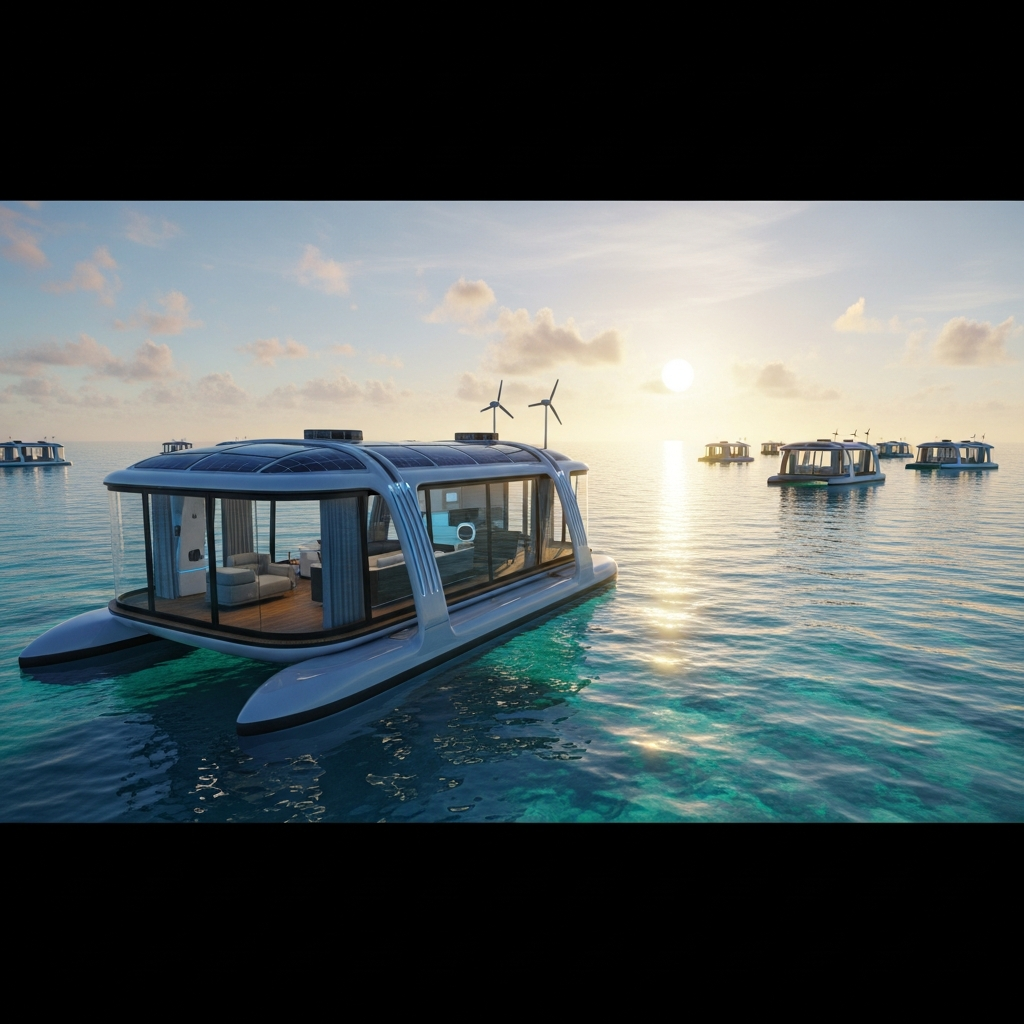
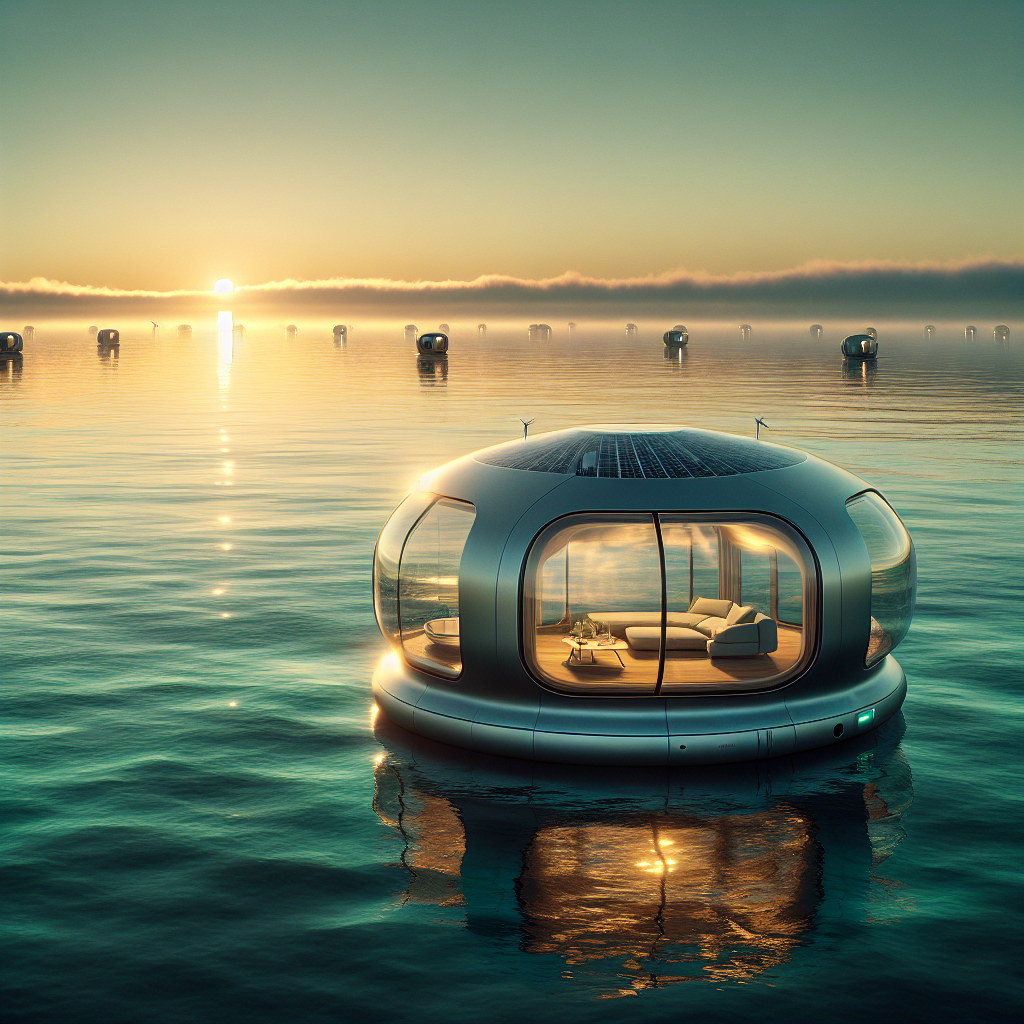
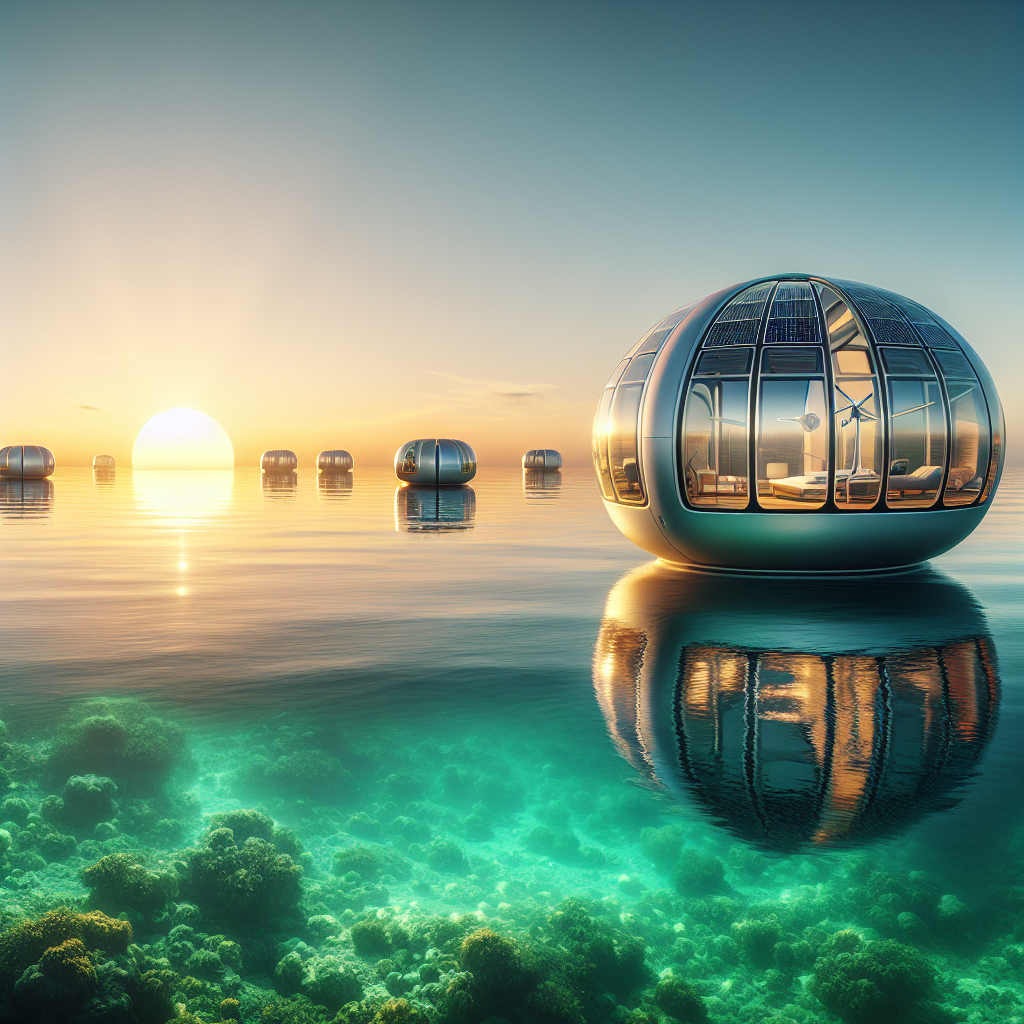
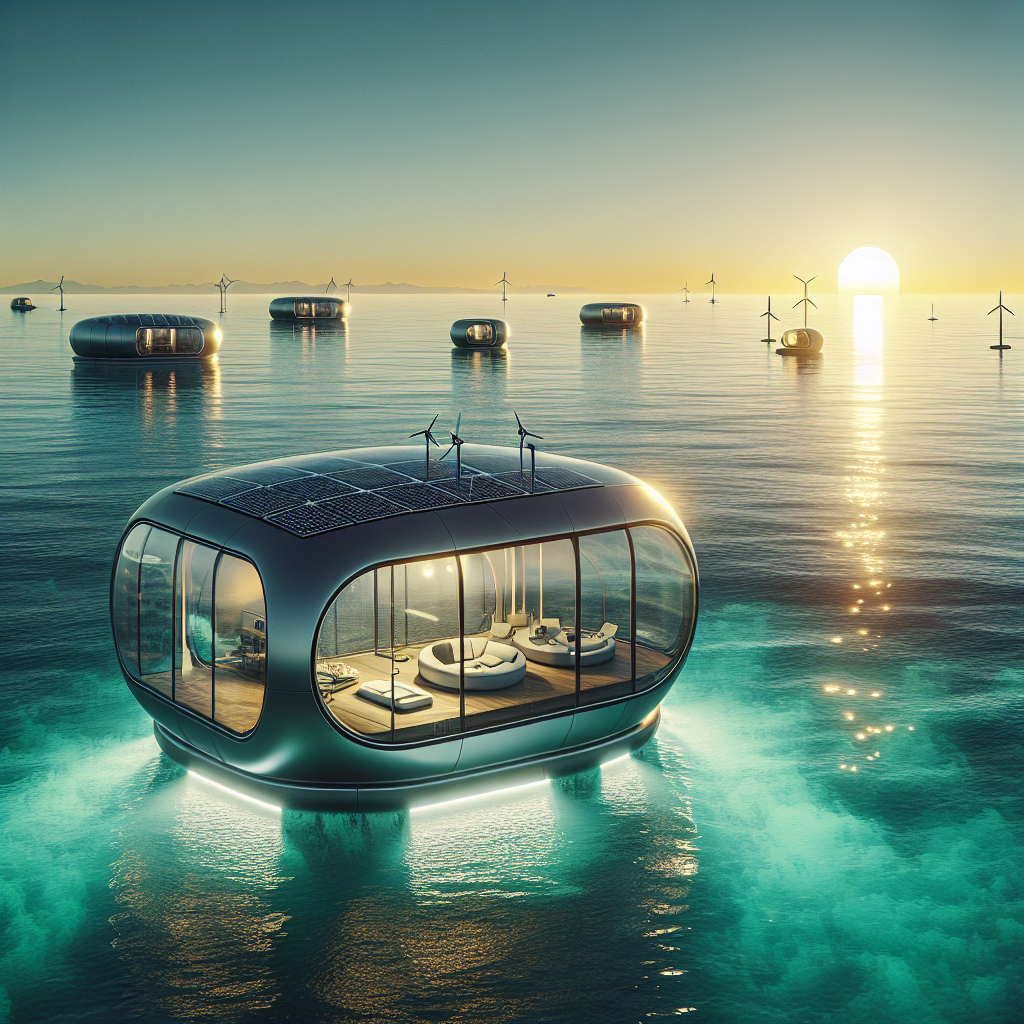
Architecturally, autonomous sea-pods borrow from both nautical minimalism and high-tech modular design. Each pod functions as a self-sufficient microcosm: solar panels shimmer across curved roofs, desalination systems hum quietly beneath the deck, and AI-driven navigation ensures optimal positioning for sunlight and weather conditions. This vision of independence aligns with the broader movement toward modular design—spaces that adapt to shifting human needs and environmental realities. In these floating units, adaptability is not a luxury but a survival mechanism. The pods can cluster into floating communities or detach for solitary voyages, mirroring the fluid social structures of the digital age. The International Maritime Organization’s 2025 report on sustainable offshore living notes that such designs could become critical as coastal populations face displacement. Floating architecture, once a utopian fantasy, is now an urgent solution.Post-National Identity and the Sea as Territory
The sea-pod movement is as much philosophical as it is architectural. It challenges the geopolitical framework that ties citizenship to land. For the “post-national citizen,” identity is defined not by borders but by bandwidth—by access to global networks and decentralized governance systems. Projects like Oceanix City, supported by the United Nations Habitat Programme, have demonstrated the feasibility of modular floating settlements that operate with near-zero emissions. Yet the autonomous sea-pod goes further: it individualizes the concept, allowing one to live, work, and connect from anywhere on the ocean’s surface. This radical mobility echoes the speculative urbanism explored in films like *Blade Runner 2049*, where technology redefines urban existence. In fact, the parallels between cinematic futurism and marine architecture are striking. As discussed in Mainifesto’s analysis of futuristic city design, the aesthetics of autonomy—neon, isolation, and fluidity—have transitioned from fiction to feasible design language.Engineering the Floating Future
The engineering behind these pods merges aerospace precision with marine resilience. Materials like carbon-fiber composites and bio-based polymers ensure both buoyancy and durability. The American Society of Civil Engineers (ASCE) has published extensive research on hydrodynamic stability and energy efficiency in offshore habitats, emphasizing the need for structures that can withstand Category 5 storms while maintaining minimal ecological impact. Energy autonomy is central to the sea-pod ethos. Solar arrays, micro wind turbines, and hydrogen fuel cells form hybrid systems that allow indefinite operation without docking. Water harvesting and closed-loop waste management make each pod a near-complete ecosystem—an architectural embodiment of the circular economy principles explored in zero-waste design.Living Systems and Biophilic Integration
Despite their technological sophistication, sea-pods are not sterile environments. Designers are increasingly incorporating biophilic principles—green walls, algae bioreactors, and aquaponic gardens—to reconnect inhabitants with living systems. The International Journal of Sustainable Design highlights that integrating natural cycles into confined habitats significantly improves mental well-being and air quality. This intersection of ecology and architecture mirrors the philosophy behind biophilic design, which argues that proximity to nature is not optional but essential for human resilience. In the context of sea-pods, it becomes a poetic act: cultivating life while floating above an ocean that is both home and horizon.Socioeconomic Implications: Freedom or Isolation?
While the sea-pod lifestyle promises autonomy, it also raises questions about community and equity. Who can afford to live untethered from land? Will these pods become sanctuaries for the privileged few, or lifeboats for climate refugees? The University of Delft’s Department of Urbanism warns that without equitable frameworks, floating architecture could replicate existing social divides on water. Yet, advocates argue that decentralized production and open-source design could democratize access. The rise of 3D-printed construction, for instance, has already reduced costs in terrestrial housing projects, as explored in Mainifesto’s coverage of 3D-printed homes.From Infrastructure to Culture
Beyond functionality, sea-pods are cultivating a new aesthetic culture—one that celebrates impermanence, transparency, and connection to the horizon. Interiors favor light-reflective materials, panoramic glazing, and modular furniture that shifts with the tides. The experience is cinematic: mornings framed by infinite blue, nights illuminated by bioluminescent waters. Architectural theorists have begun to describe this as “hydro-modernism”—a movement that redefines the relationship between human habitat and the planetary hydrosphere. It’s a design language that acknowledges the ocean not as a barrier but as a continuum of possibility.The Ethics of Floating Freedom
As sea-pods multiply, they will inevitably challenge maritime law, environmental ethics, and the concept of national jurisdiction. The United Nations Convention on the Law of the Sea (UNCLOS) provides a framework, but autonomous living units blur the line between vessel and territory. Architects and policymakers must therefore engage in a dialogue that balances innovation with stewardship. The future of floating living is not just about escaping land—it’s about redefining coexistence with the planet’s most dynamic ecosystem.Conclusion: The Ocean as the Next Urban Frontier
The autonomous sea-pod is more than a design innovation; it is a cultural manifesto. It invites us to imagine a civilization unmoored from borders, powered by renewable energy, and guided by ecological intelligence. In a century defined by migration and climate flux, these floating habitats may become the prototypes of a new kind of citizenship—one that is mobile, sustainable, and deeply attuned to the rhythms of the Earth. As humanity learns to live with water rather than against it, the ocean will cease to be the edge of civilization. It will become its foundation. —{
"seo_title": "Floating Nomads: Autonomous Sea-Pods",
"meta_description": "Explore autonomous sea-pods—floating homes redefining post-national living and sustainable ocean architecture.",
"excerpt": "Could the ocean become our next city? Discover how autonomous sea-pods are redefining post-national living through design, technology, and sustainability.",
"focus_keyphrase": "autonomous sea-pods"
}
AI Image Prompts
1. **Prompt:** Photorealistic image of a futuristic autonomous sea-pod floating on calm turquoise waters, solar panels glinting under morning light, shot on a Hasselblad H6D, ultra-high resolution. **Alt text:** Autonomous sea-pod with solar panels on open ocean. **Caption:** A vision of self-sufficient living—solar-powered sea-pods redefine independence on the high seas. 2. **Prompt:** Aerial view of a cluster of interconnected sea-pods forming a floating community, surrounded by coral reefs, golden hour lighting, Hasselblad medium format clarity. **Alt text:** Floating sea-pod community forming modular network on ocean. **Caption:** Modular living meets marine ecology—floating neighborhoods built for the post-national citizen. 3. **Prompt:** Interior of a sea-pod featuring panoramic glass walls, minimalist furniture, and integrated hydroponic garden, natural daylight filtering through. **Alt text:** Interior of sea-pod with hydroponic garden and ocean view. **Caption:** Inside the pod: biophilic design merges comfort, sustainability, and serenity. 4. **Prompt:** Nighttime scene of a single illuminated sea-pod drifting under a star-filled sky, bioluminescent waves glowing around it, Hasselblad long exposure. **Alt text:** Sea-pod glowing at night surrounded by bioluminescent water. **Caption:** A solitary sea-pod becomes a beacon of light in the vast nocturnal ocean. —Social Media Strategy
×
![Imatge ampliada]() ❮
❯
❮
❯