
Night-sky tapestries: cosmic star charts woven into ceiling fabrics
Night-Sky Tapestries: Cosmic Star Charts Woven into Ceiling Fabrics
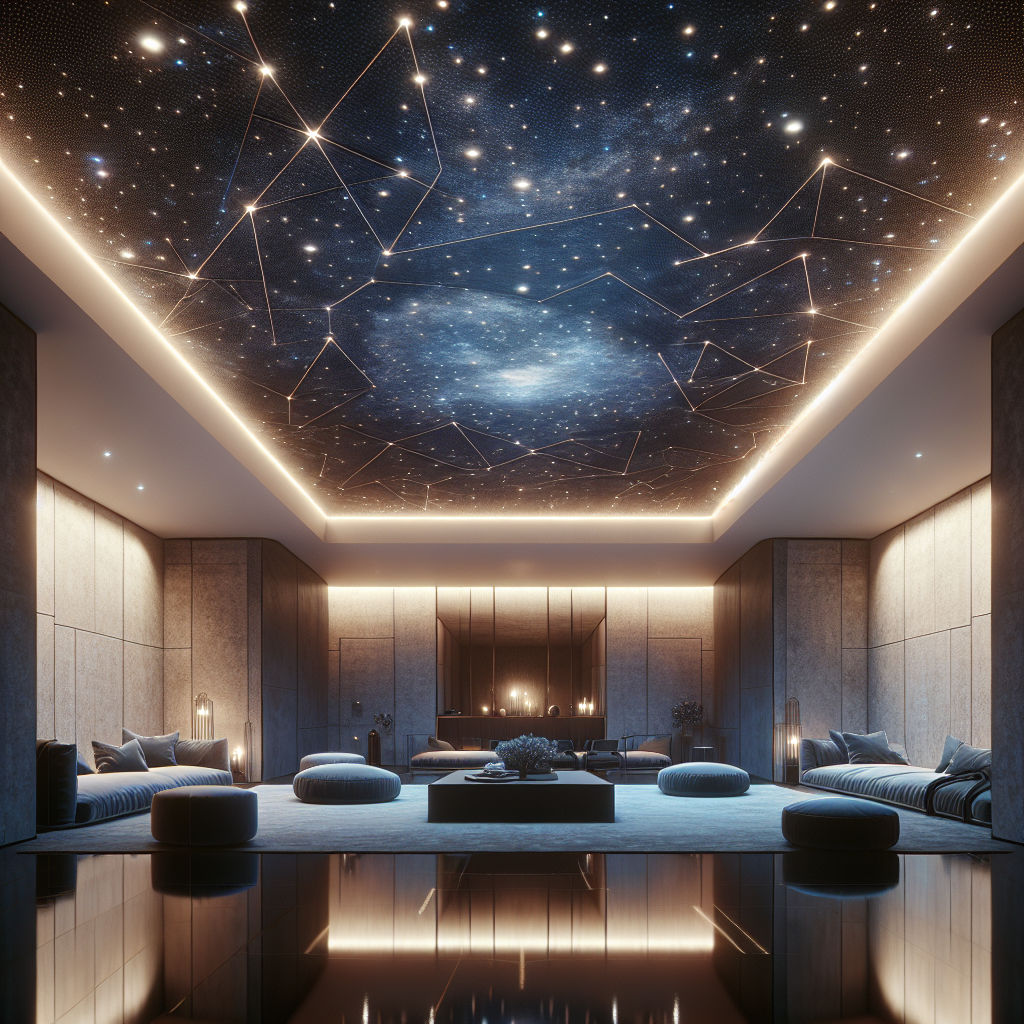
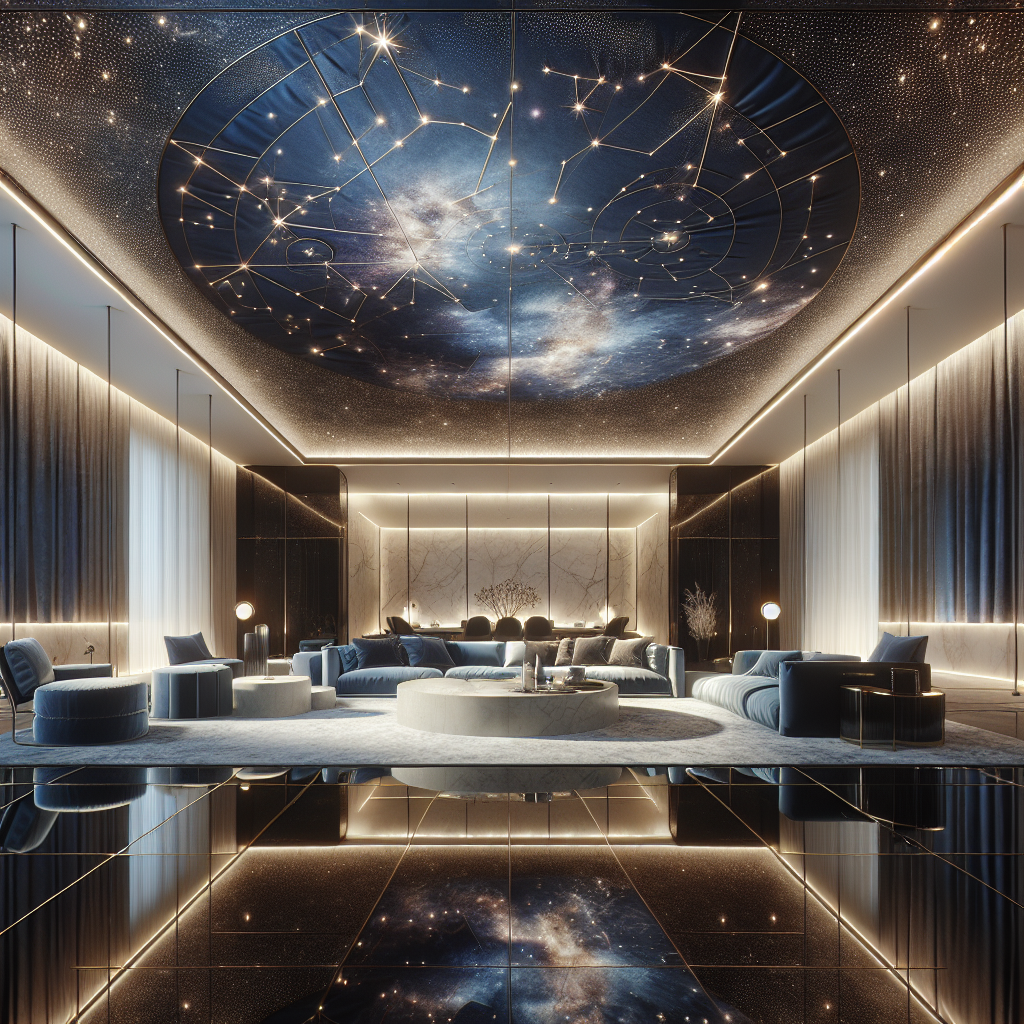
There is a quiet revolution unfolding above our heads. In the most refined interiors—from boutique hotels in Kyoto to private observatories in the Swiss Alps—designers are transforming ceilings into celestial canvases. These night-sky tapestries, woven with intricate cosmic star charts, merge the precision of astronomical mapping with the tactile poetry of textile art. The result is a new form of architectural storytelling: immersive, contemplative, and profoundly human.
The Celestial Turn in Contemporary Interiors
In recent years, interior design has gravitated toward sensory depth and emotional resonance. As architects and designers seek to craft spaces that evoke wonder rather than mere function, the cosmos has emerged as a powerful muse. According to the cosmic microwave background—the faint afterglow of the Big Bang—our universe is not only vast but textured, patterned, and filled with subtle gradations of light. Translating that sense of infinite continuity into interior surfaces has become a defining ambition of avant-garde studios.
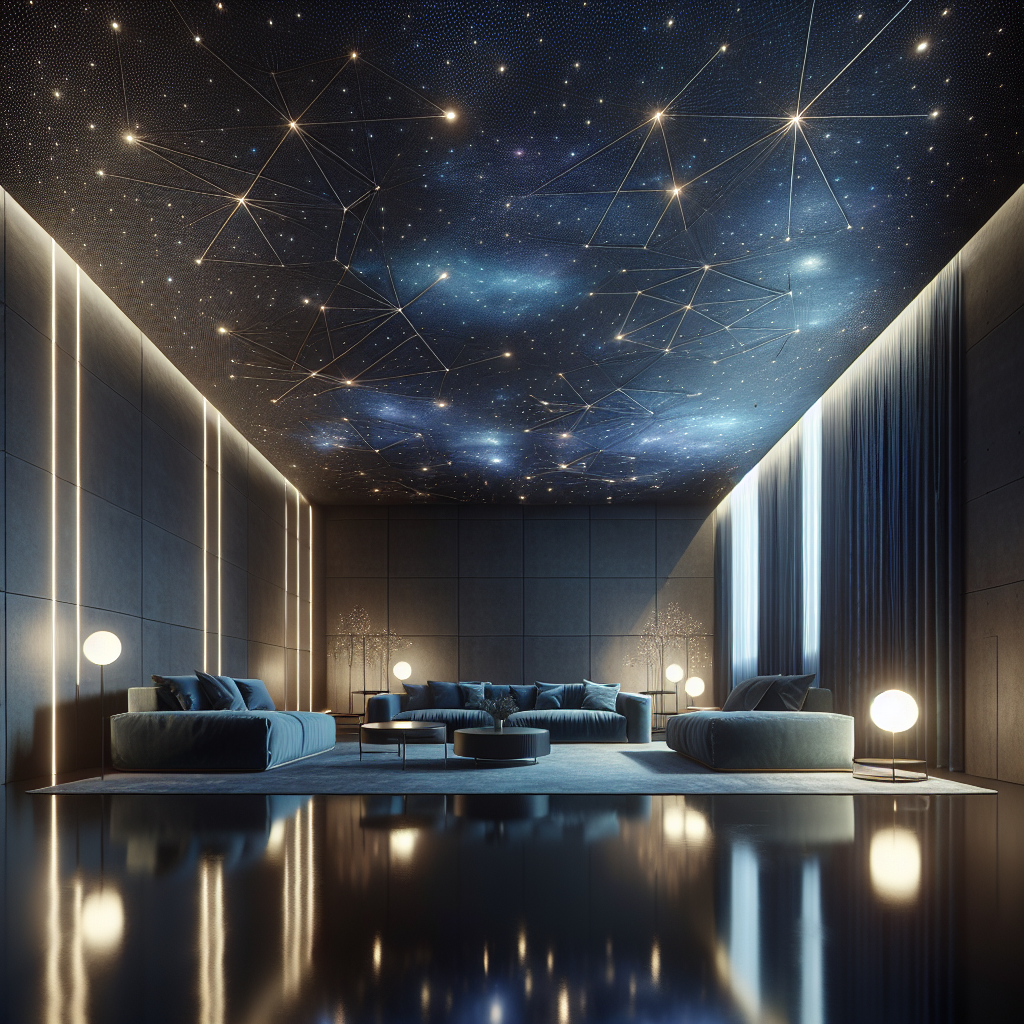
Unlike the traditional frescoed ceilings of the Renaissance, today’s celestial ceiling fabrics are woven with advanced fibers, often incorporating metallic threads, optical filaments, or programmable LEDs. These materials capture and refract light, creating a dynamic interplay between darkness and illumination that shifts with the time of day. The effect is both meditative and futuristic—a reminder of humanity’s enduring fascination with the stars.
From Astronomy to Artistry: The Craft of Cosmic Weaving
The creation of a night-sky tapestry begins with data. Designers collaborate with astronomers to translate authentic star maps—often derived from Hipparcos or Gaia satellite data—into textile patterns. Each pinpoint of light corresponds to a real celestial coordinate, scaled and stylized to suit the architectural context. The resulting fabric is not merely decorative; it is a woven archive of the universe’s geometry.
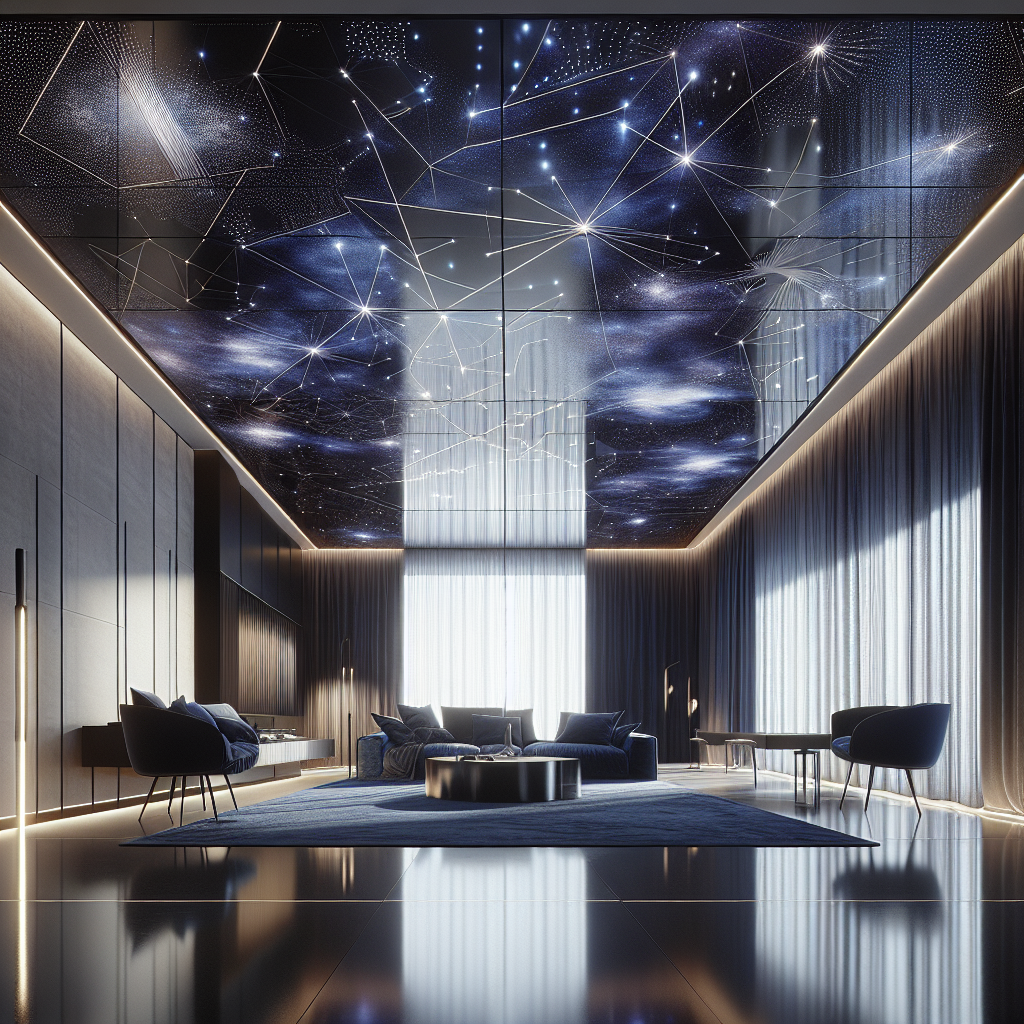
In ateliers across Europe and Japan, master weavers employ Jacquard looms programmed with astronomical algorithms. Metallic threads trace constellations like Orion or Cassiopeia, while gradient-dyed silks evoke the Milky Way’s diffuse glow. Some studios, such as Atelier Neige in Lyon, integrate fiber optics directly into the weave, allowing constellations to shimmer in response to ambient sound or movement. This synthesis of craft and computation recalls the spirit of digital fabrication—where precision engineering meets poetic expression.
Architectural Integration: Ceilings as Celestial Portals
In architectural terms, the ceiling has long been a neglected plane. Yet in recent years, designers have rediscovered its potential as a site of narrative and atmosphere. The night-sky tapestry ceiling transforms this horizontal surface into a spatial experience that invites upward contemplation. When paired with subtle lighting and acoustic insulation, these woven star maps can alter the perceived volume of a room, creating an illusion of infinite height.
In a private residence overlooking Lake Como, Milan-based studio Forme Nere installed a custom tapestry woven with the coordinates of the client’s birth constellation. The ceiling’s deep indigo silk base absorbs light during the day, while embedded optical fibers softly illuminate at dusk, simulating the gradual emergence of stars. The result is a seamless transition between architecture and astronomy—a private cosmos within domestic space.
Such installations also align with the growing emphasis on biophilic design. Just as natural materials and greenery reconnect inhabitants with the earth, celestial motifs reorient them toward the sky. The ceiling becomes a contemplative surface that reminds us of our place within a larger continuum—an antidote to the sensory overload of urban life.
Material Innovation: The Fusion of Light, Fiber, and Data
The technical sophistication behind these tapestries is remarkable. Advances in e-textiles and smart fibers have enabled designers to embed micro-LEDs, conductive threads, and responsive polymers directly into woven structures. This allows for subtle, programmable illumination that mimics the natural twinkle of starlight. Some systems are even synchronized with astronomical cycles, adjusting brightness according to lunar phases or real-time celestial events.
In 2024, a collaboration between the Kyoto Textile Research Institute and European lighting designers resulted in the “Celestia” series—woven panels that respond to environmental data such as humidity and temperature. The fibers expand or contract, altering the density of the weave and subtly changing the pattern’s luminosity. This interplay between environmental feedback and aesthetic form echoes the adaptive principles explored in responsive architecture.
Moreover, sustainability is central to this innovation. Many contemporary studios use recycled metallic threads or biodegradable fibers, aligning with the broader movement toward biodegradable architecture. The night-sky tapestry thus becomes not only a symbol of cosmic wonder but also a statement of ecological responsibility.
Case Studies: From Planetariums to Boutique Hotels
In Tokyo’s Shibuya district, the recently opened Hoshizora Lounge features a vaulted ceiling woven with a digital star chart of the Northern Hemisphere. The fabric, a blend of silk and optical fiber, glows softly as guests dine beneath a canopy of constellations. The installation was designed to evoke the serenity of stargazing in a city where true darkness is rare. It exemplifies how celestial design can restore a sense of natural rhythm within urban environments.
Meanwhile, in Iceland’s northern coast, the Aurora Spa integrates night-sky tapestries into its geothermal relaxation chambers. The ceilings, dyed in deep ultramarine and interlaced with phosphorescent threads, absorb daylight and release it gradually after sunset. This creates a gentle, aurora-like shimmer that mirrors the region’s natural phenomena. The installation demonstrates how cosmic-inspired interiors can harmonize with local geography and light conditions.
Even commercial spaces are embracing this celestial aesthetic. A London-based co-working hub recently unveiled a “Galactic Hall,” where woven star maps double as acoustic panels. The integration of sound absorption and visual storytelling illustrates the multifunctional potential of textile-based design interventions.
The Psychology of the Celestial Interior
Beyond their visual allure, night-sky tapestries exert a profound psychological influence. Studies in environmental psychology suggest that exposure to expansive visual fields—such as starry skies—can reduce stress and enhance cognitive clarity. By replicating this effect indoors, designers are effectively creating microcosms of tranquility. The ceiling becomes a meditative interface, encouraging introspection and creative thought.
This approach resonates with the growing demand for interiors that support mental well-being. In a world increasingly defined by screens and artificial light, the reintroduction of cosmic imagery offers a subtle recalibration of perspective. It invites occupants to look up, to pause, and to reconnect with the rhythms of the universe.
Future Horizons: The Convergence of Science and Sensibility
As material science and digital fabrication continue to evolve, the potential of cosmic ceiling fabrics will expand exponentially. Future iterations may incorporate photovoltaic threads capable of harvesting ambient light energy, echoing innovations seen in solar textile design. Others may use augmented reality overlays to project live astronomical data onto woven constellations, merging tactile craft with digital dynamism.
Ultimately, the allure of night-sky tapestries lies in their duality: they are both ancient and futuristic, intimate and infinite. They remind us that architecture is not merely about shelter but about orientation—toward the earth beneath our feet and the cosmos above our heads. In an age of technological acceleration, these woven star charts offer a rare form of stillness: a quiet dialogue between fabric, light, and the vastness of space.
In the words of one Kyoto-based designer, “We no longer paint ceilings to depict heaven. We weave them to remember that we are already part of it.”
Get the Mainifesto weekly — curated design debates, speculative ideas and the week's best articles every Saturday.